


News


Precision Glass Balls Supplier for Calibration and Laboratory Applications
Precision glass balls in calibration systems and measurement accuracy control
In precision-driven industries, dimensional stability is not optional—it is fundamental. Precision glass balls are widely used as reference components in calibration systems where repeatability, stability, and predictable geometry directly influence measurement outcomes.
Unlike metallic alternatives, glass-based spheres provide a unique combination of chemical inertness and dielectric behavior. This makes them especially valuable in environments where electrical interference or corrosion could distort calibration results. In laboratory instrumentation, even minor deviations in roundness can introduce systematic errors, so strict geometric control becomes essential.
For calibration engineers, consistency across batches is just as important as individual accuracy. When precision components are used as reference standards, they must maintain identical physical behavior across time, temperature shifts, and repeated handling cycles. This is where controlled manufacturing processes become a decisive factor in quality assurance. In this blog post, Changzhou Eurasian, as high quality custom precision glass balls supplier, will share its applications in calibration and laboratory fields.
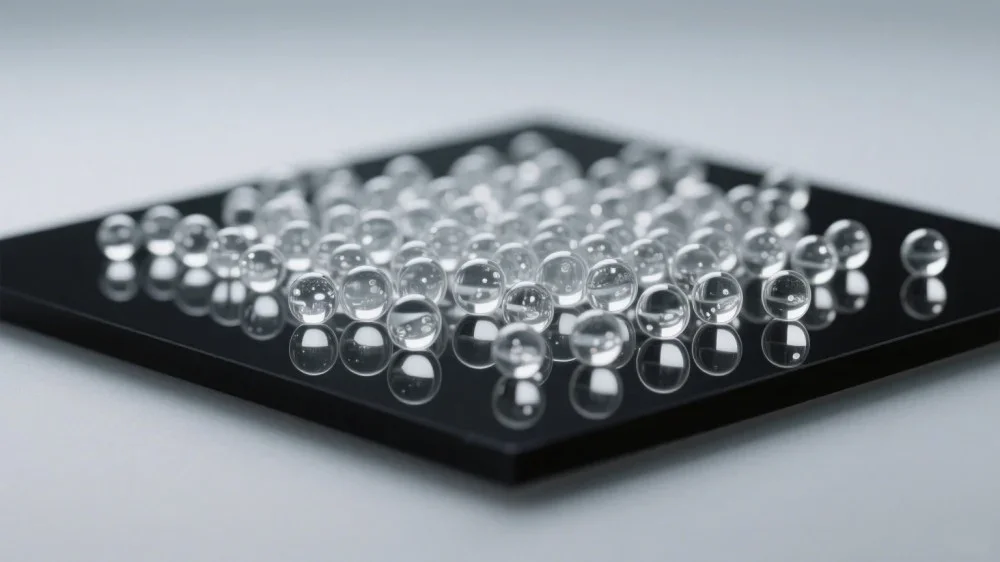
Material engineering behind precision glass balls for laboratory environments
The performance of precision glass balls for laboratory applications is strongly determined by material composition. Two primary material systems are commonly used in advanced manufacturing environments.
Soda lime based precision glass spheres in controlled environments
Soda lime glass is widely used where moderate thermal conditions and stable mechanical contact are required. Its advantages include low density, good surface uniformity, and strong resistance to corrosion in standard laboratory environments. It is particularly suitable for fluid control systems, analytical devices, and general-purpose calibration fixtures.
A key characteristic is its ability to maintain structural integrity under continuous moderate temperatures, making it suitable for long-duration laboratory experiments where thermal fluctuations are limited but consistency is required.
Borosilicate precision glass spheres for thermal and chemical stability
Borosilicate-based formulations are designed for demanding laboratory conditions involving heat cycling and chemical exposure. This material exhibits superior resistance to thermal shock and maintains structural stability under rapid temperature transitions.
In high-end laboratory systems, borosilicate precision glass balls are often selected for their dielectric strength and chemical neutrality. These properties ensure that experimental conditions remain unaffected by the calibration component itself, preserving measurement integrity.
Dimensional control in precision glass balls manufacturing process
Achieving high-grade precision glass balls supplier standards requires multi-stage process control. Dimensional accuracy is not achieved in a single step but through tightly controlled sequential manufacturing stages.
Raw material selection and purity control
The first stage begins with glass composition control. Impurities at this stage can introduce micro-defects that later affect sphericity and surface uniformity. High-purity feedstock ensures predictable thermal and mechanical behavior during forming.
Controlled forming and spherical stabilization
During forming, molten glass is shaped under carefully regulated conditions to ensure uniform mass distribution. The cooling phase is equally critical, as uneven cooling can generate internal stress, leading to deformation under load.
Precision polishing and surface finishing
Surface quality directly affects friction, optical reflection, and interaction behavior in laboratory systems. Polishing processes are used to achieve controlled surface roughness levels, ensuring predictable interaction with fluids, gases, or mechanical interfaces.
Metrology-based inspection systems
Advanced measurement systems verify diameter tolerances, roundness deviation, and surface consistency. High-precision optical and mechanical inspection ensures batch-to-batch uniformity, which is essential for repeatable laboratory performance.
Functional behavior of precision glass balls in laboratory applications
The use of precision glass balls in laboratory applications extends across multiple functional roles, depending on system design requirements.
Flow regulation and fluid dynamics control
In fluid measurement systems, spherical elements act as passive control components that regulate flow behavior. Their geometry ensures predictable movement and stable sealing behavior under controlled conditions.
Dielectric isolation in sensitive measurement equipment
Because glass exhibits strong electrical resistance, it is frequently used in environments where electrical isolation is required. This helps prevent signal distortion in sensitive measurement instruments.
Chemical resistance in analytical systems
Laboratory environments often involve reactive chemicals. Glass spheres maintain structural integrity without reacting with most acids, solvents, or organic compounds, ensuring long-term stability in analytical systems.
Mechanical stability in precision assemblies
In mechanical systems, consistent spherical geometry reduces friction variability. This contributes to stable performance in assemblies where controlled motion or load distribution is required.
Industrial integration of precision glass balls supplier solutions
A professional precision glass balls supplier for calibration systems must support a wide range of industrial requirements, not only in product quality but also in supply chain reliability and technical consistency.
Multi-industry compatibility requirements
Laboratory-grade spheres are often integrated into diverse sectors including instrumentation engineering, fluid control systems, analytical chemistry equipment, and precision mechanical assemblies. Each application imposes different performance expectations, requiring flexible specification control.
Dimensional range and customization flexibility
Industrial users frequently require different diameter ranges depending on system design. A broad size spectrum allows engineers to select optimal geometry for specific calibration tolerances and mechanical constraints.
Surface finish options also play a role in system performance. Polished surfaces are typically used where minimal friction is required, while matte finishes may be preferred in controlled interaction systems.
Stability across production batches
One of the most important factors in industrial sourcing is consistency. Even when individual units meet tolerance requirements, variation between batches can affect calibration reliability. Controlled production systems ensure uniform behavior across large-scale supply.
Engineering considerations in precision glass balls selection
Selecting the correct precision glass balls for laboratory and industrial systems requires evaluation of multiple engineering parameters beyond basic size specifications.
Thermal stability requirements
Different systems operate under varying temperature conditions. Material selection must align with expected thermal exposure to prevent deformation or stress-related failure.
Chemical compatibility assessment
Laboratory environments often involve aggressive chemical agents. Compatibility evaluation ensures that the selected glass composition will not degrade or interact with surrounding substances.
Mechanical load distribution behavior
In mechanical systems, load distribution is influenced by surface contact geometry. Spherical precision components must maintain shape integrity under repeated mechanical stress.
Electrical insulation performance
In instrumentation systems where electrical interference must be minimized, dielectric properties become a critical selection factor.
Quality assurance systems for precision glass balls production
High-level precision glass balls supplier operations rely on integrated quality management systems that control every stage of production.
Process standardization and certification control
Manufacturing systems are aligned with international quality frameworks to ensure consistent output and traceability. Standardization reduces variability and improves reliability in end-use applications.
Statistical process control implementation
Continuous monitoring of production parameters ensures early detection of deviations. This allows corrective action before nonconforming products reach final inspection stages.
Batch traceability systems
Each production batch is tracked through raw material input, processing stages, and final inspection results. This supports long-term quality validation and customer confidence in repeat procurement.
Long-term performance behavior in laboratory systems
The durability of precision glass balls in calibration environments is influenced by both material composition and usage conditions. Over time, stability depends on resistance to thermal cycling, chemical exposure, and mechanical interaction.
In controlled laboratory environments, properly manufactured glass spheres maintain geometric integrity over extended periods, reducing recalibration frequency and improving system reliability. This long-term stability is essential in precision measurement systems where even minor deviations can accumulate into significant analytical errors.
Supplier capability requirements in global precision markets
A reliable precision glass balls supplier for calibration applications must meet global expectations in production capacity, technical support, and export readiness.
Scalable production systems
Industrial demand often fluctuates between small laboratory orders and large-scale OEM requirements. Scalable manufacturing ensures that supply remains consistent regardless of order size.
Technical consultation support
Engineering teams often require guidance on material selection and specification matching. Supplier expertise becomes a key factor in optimizing system performance.
Packaging and logistics control
Precision components require secure packaging to prevent surface damage during transportation. Export-grade packaging systems ensure dimensional integrity upon delivery.
Conclusion
The role of precision glass balls in calibration and laboratory applications is defined by strict requirements for dimensional accuracy, material stability, and long-term reliability. Their integration into measurement systems supports accurate data acquisition, stable mechanical performance, and consistent experimental outcomes.
Through controlled material selection, precision manufacturing, and rigorous inspection systems, Eurasian provides glass spheres designed for demanding industrial and laboratory environments where accuracy is non-negotiable.
FAQ
Q1: What are precision glass balls used for in laboratory applications?
They are used in calibration systems, flow control devices, analytical instruments, and measurement equipment where stable geometry and consistent physical behavior are required.
Q2: What materials are available for precision glass balls?
Common materials include soda lime glass for general applications and borosilicate glass for high-temperature, chemical-resistant, and high-stability laboratory environments.
Q3: What tolerance can precision glass balls achieve?
High-grade precision glass balls can achieve dimensional tolerances up to ±0.02mm depending on production control and inspection standards.
Q4: Can precision glass balls withstand chemical exposure?
Yes. Both soda lime and borosilicate glass offer strong chemical resistance, making them suitable for laboratory and industrial environments involving reactive substances.
Q5: What industries commonly use precision glass balls?
They are widely used in laboratory instrumentation, calibration systems, flow meters, pharmaceutical equipment, food processing machinery, and precision mechanical assemblies.


