

News

Beyond "Zero Defects": How We Eliminated Line, Spot, & Bipolar Grinding Burns in High-Precision Steel Balls
In the world of high-speed precision bearings operating at 50,000+ RPM, the "Grinding Burn" is often called the "Invisible Killer." It alters the metallographic structure of the steel ball surface, leading to stress concentration and premature fatigue spalling that can slash bearing life by 60-80%.
Many suppliers categorize this as a generic "burn defect." However, at Changzhou Eurasian Steel Ball Co., Ltd., as an IATF 16949:2016 certified Tier-2 supplier with proprietary CQI-9 heat treatment facilities, we know that generic solutions cannot solve specific problems.
Based on our Three-Dimensional Burn Control System, we have successfully identified, categorized, and engineered solutions for three distinct types of grinding burns: Line Burns, Spot Burns, and Bipolar Burns.
1. Line Burns: The "Slippage" Defect
Visual Signature: Dark, parallel streaks running along the ball surface, resembling railway tracks.
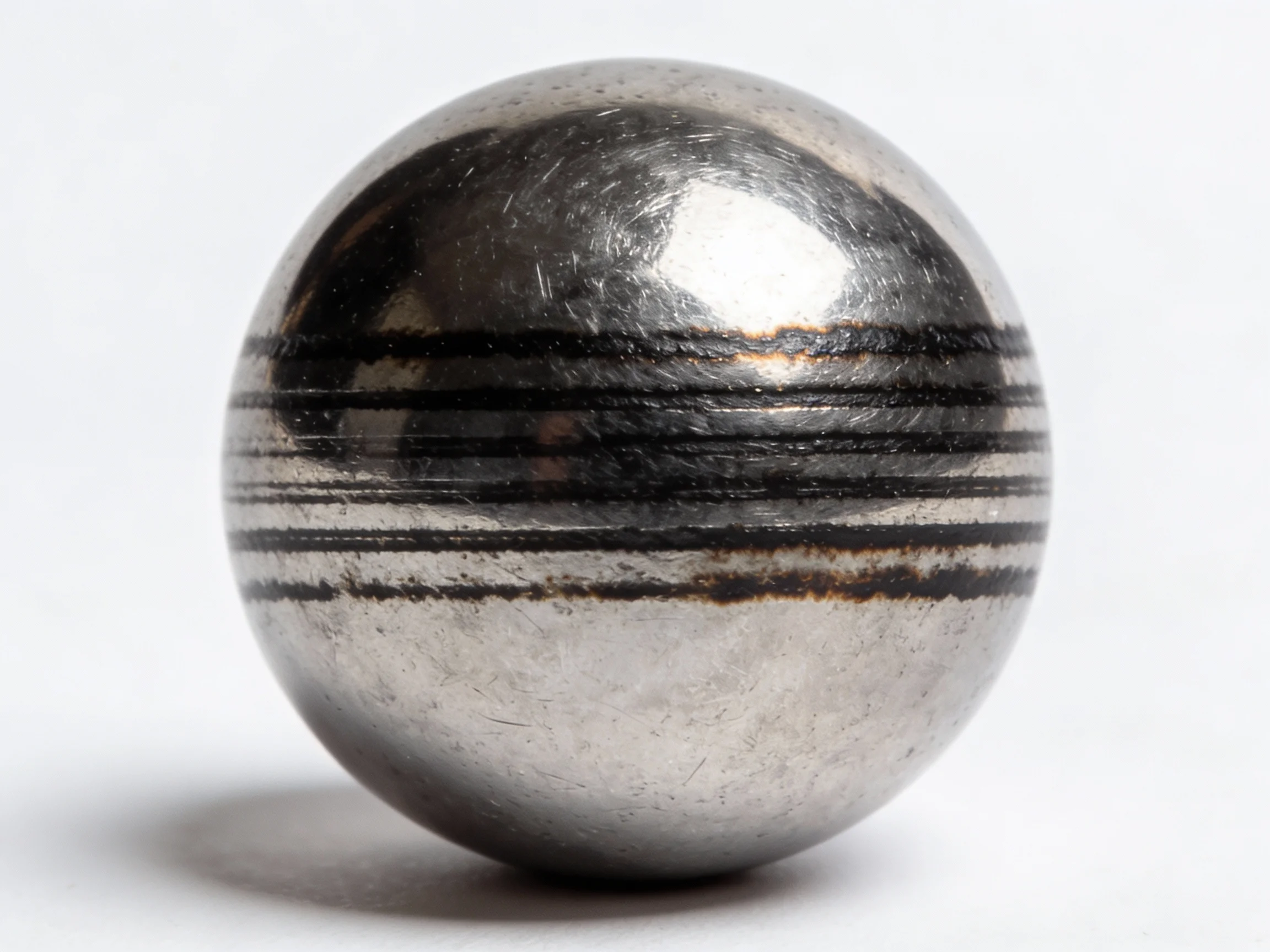
Root Cause Analysis
Line burns occur when the steel ball slips rather than rolls smoothly in the grinding groove. This friction-induced heat concentration is triggered by:
Dead Angles: Balls becoming trapped in entry/exit transition zones
Groove Depth Inconsistency: Uneven pressure distribution across the contact arc
Plate-to-Wheel Misalignment: Creates localized "drag zones" instead of rolling motion
The Eurasian Engineering Solution
We deploy Micron-Level Stationary Plate Calibration:
Trumpet Angle Optimization: Precisely control the entry funnel geometry to ensure smooth ball engagement
Groove Alignment Protocol: Laser-verified synchronization between stationary plate and grinding wheel grooves
Real-Time Monitoring: Vibration sensors detect early signs of "dead friction" before burns manifest
Result: Elimination of linear heat damage zones, confirmed by sub-surface hardness profiling (HRC variance < 1 unit).
2. Spot Burns: The "Impact" Injury
Visual Signature: Isolated, cloud-like or dot-shaped discoloration zones, often appearing as random "bruises."
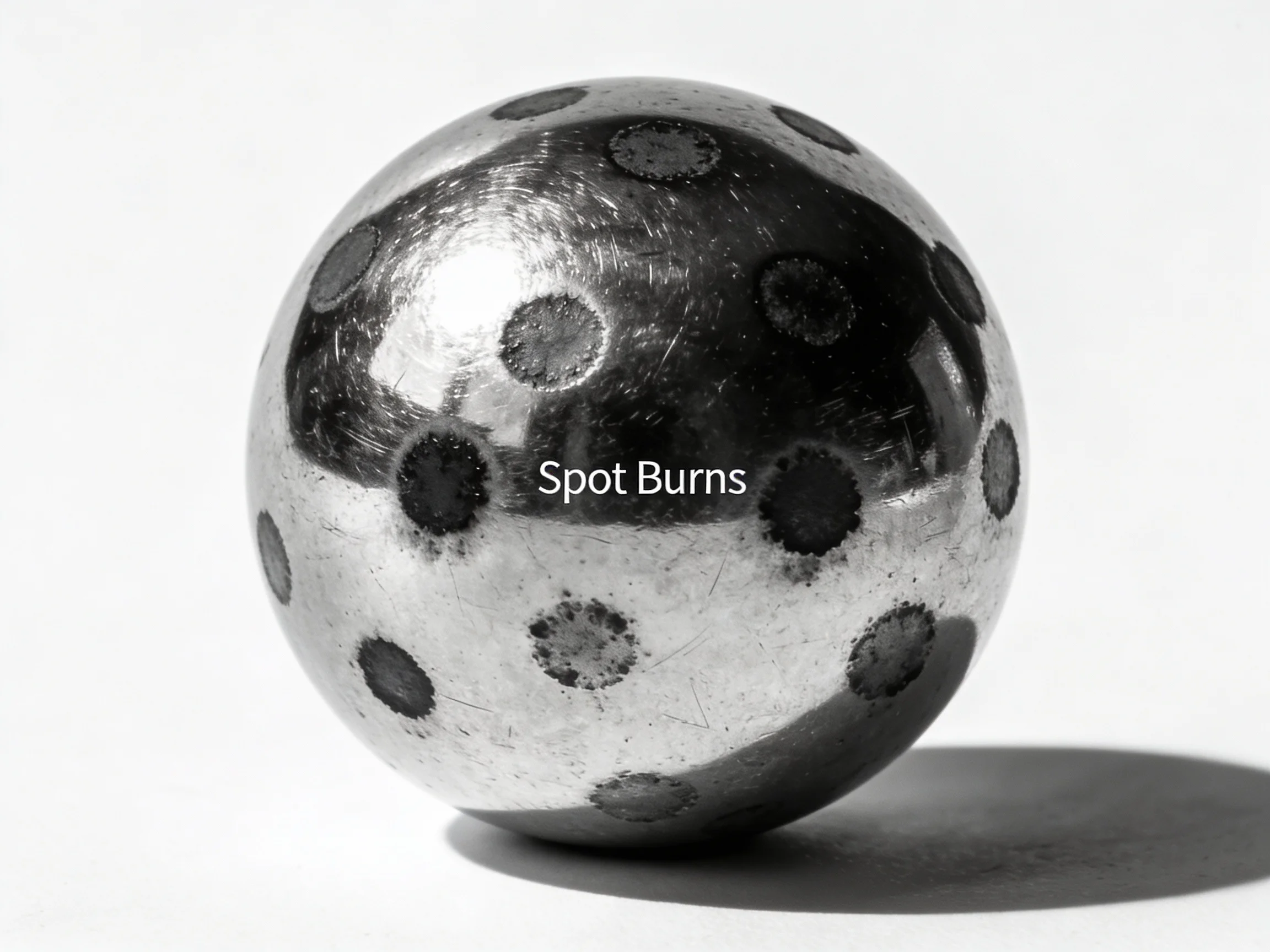
Root Cause Analysis
Spot burns are "accidental" defects triggered by:
Foreign Debris Contamination: Grinding wheel fragments or metal chips acting as "hard contact points" between plate and ball
Coolant Splashing/Starvation: Uneven cooling creating localized "secondary quenching" zones
Spindle Vibration: Wheel runout causing intermittent impact-induced heating
The Eurasian Engineering Solution
We treat our coolant system as a vascular network:
Magnetic Filtration Upgrade: Removes ferrous particles down to 5-micron level using rare-earth magnet arrays
Dynamic Spindle Balancing: Continuous vibration monitoring keeps wheel runout below 0.002mm
Flood Coolant Zoning: Strategic nozzle placement ensures uniform thermal management across the entire ball surface
Result: Pristine surfaces free from impact-induced phase transformations, verified by Nital etch metallographic inspection.
3. Bipolar Burns: The "Dead Angle" Killer
Visual Signature: Symmetrical burn marks appearing on opposite poles (180° apart) of the ball.
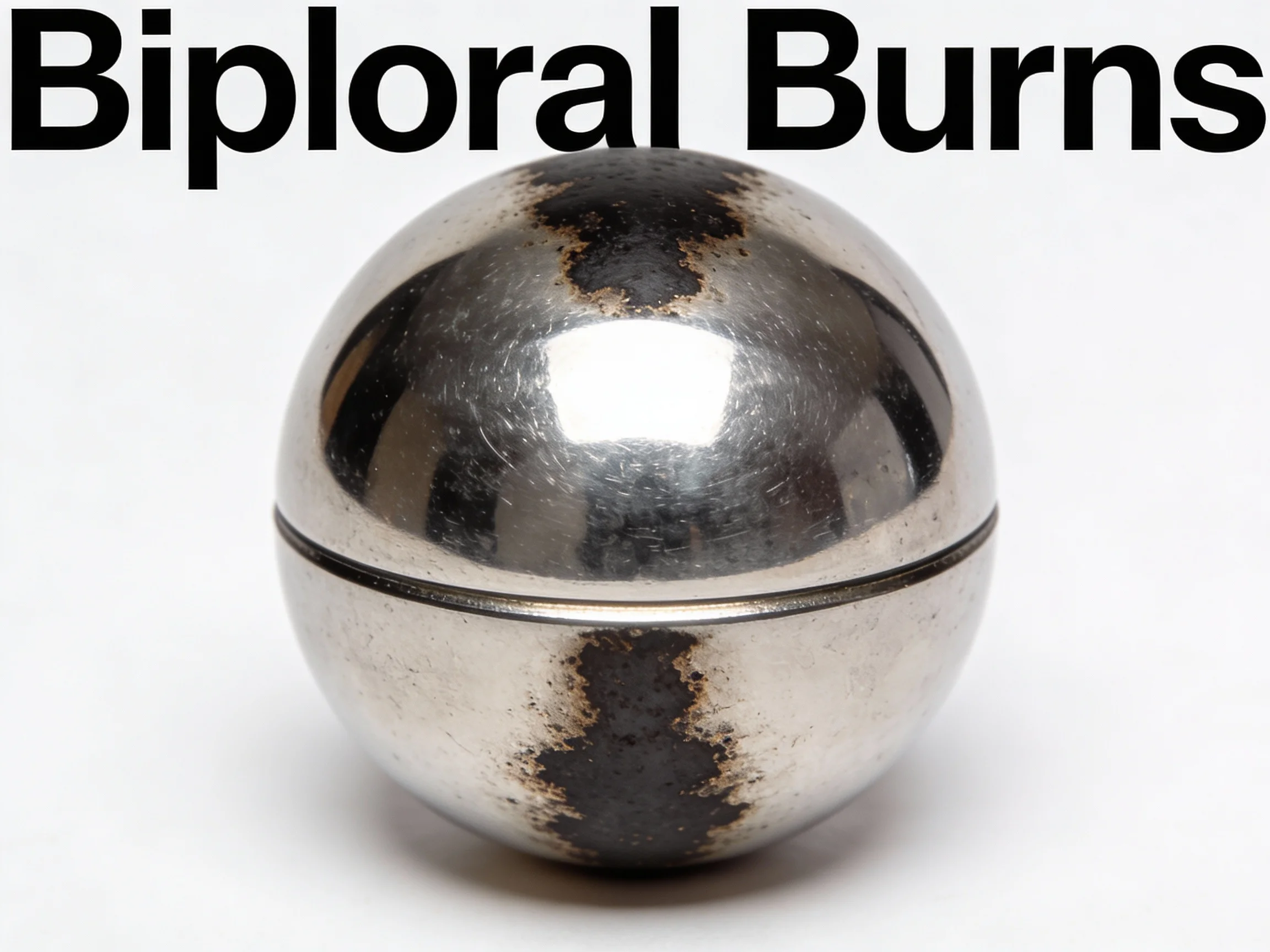
Root Cause Analysis
This is a geometric failure mode. Bipolar burns occur when:
Two-Point Contact: The ball only contacts the groove at two diametrically opposed points (poles) instead of seated across the full arc
Groove-Ball Radius Mismatch: Creates extreme localized pressure and frictional heat at the poles while the equator remains cool
Oversized Raw Material: Pre-hardened balls exceeding tolerance jam in the groove, forcing polar-only contact
The Eurasian Engineering Solution
Groove Geometry Re-Engineering: Optimized Gothic arch profile vs. traditional circular arc - ensures 3-point contact distribution instead of 2-point
Pre-Grind Roller Screening: High-precision optical sizing (±0.5μm resolution) removes oversized or distorted raw bearing steel balls before fine grinding
Dressing Tool Precision: CNC-controlled wheel dressing maintains groove curvature within ±0.001mm throughout the production run
Result: Uniform heat distribution verified by infrared thermal imaging during grinding - no polar hot spots detected.
The Ultimate Verification: Cold Acid Etch Inspection
Process control is our shield, but metallographic inspection is our sword.
We do not rely on naked-eye visual inspection. Our ISO-certified Quality Lab performs:
Cold Acid Etch Protocol (Nital 2% Solution)
Reveals Microstructural Changes: Exposes "invisible" zones of untempered martensite or overtempered regions
Confirms Metallurgical Integrity: Ensures the sub-surface retains proper tempered martensite structure (no phase transformation artifacts)
Batch Validation: Statistical sampling per AQL 1.5 standard across every production lot
Comparison:
| Inspection Method | Detection Rate | False Negative Risk |
|---|---|---|
| Visual (Naked Eye) | 40-60% | High |
| Magnetic Particle | 70-80% | Moderate |
| Cold Acid Etch | 95-98% | Minimal |
Proven Performance: 10X Fatigue Life Extension
Internal accelerated life testing confirms that our GCr15 (AISI 52100) chrome steel balls free from these three specific burn types achieve:
Fatigue Life: Exceeding 10x the L10 rating per ISO 281 calculation
Retained Hardness: Post-grind hardness deviation < 1 HRC from core hardness
Zero Premature Failures: In field testing with automotive tier-1 customers over 200,000 km durability cycles
Ready for the Global Supply Chain
Whether you are engineering precision bearings for SKF, Bosch, or high-performance EV drivetrains, you need a manufacturing partner who understands the metallurgy behind the shine.
Why Tier-1 OEMs Choose Eurasian Steel Balls:
IATF 16949:2016 automotive quality certification
CQI-9 compliant in-house heat treatment (quench + temper)
In-house Lab: Roundness tester, Rockwell hardness tester, spectrometer, vibration analyzer
Bureau Veritas (BV) factory audit certified
FAQ: Grinding Burns in Precision Steel Balls
Q1: Can grinding burns be detected during incoming inspection?
A: Standard visual inspection misses 40-60% of grinding burns. Acid etch testing or magnetic particle inspection is required for reliable detection. We provide full metallographic reports with every shipment.
Q2: What is the difference between Line Burns and Spot Burns?
A: Line Burns are systematic defects caused by process geometry (slippage), while Spot Burns are random events from contamination or cooling failures. Line Burns are preventable through equipment calibration; Spot Burns require filtration and monitoring systems.
Q3: Do all steel ball grades suffer from grinding burns equally?
A: Higher carbon grades (GCr15/52100, 440C stainless) are more susceptible due to their hardness (HRC 60-65). Softer grades like 304 stainless show burns less frequently but still require process control.
Q4: How does grinding burn affect bearing life in high-speed applications?
A: Grinding burns create sub-surface stress risers that initiate fatigue cracks. In high-speed bearings (>30,000 RPM), this can reduce L10 life by 60-80% and cause catastrophic spalling failure.
Q5: Can grinding burns be "fixed" after detection?
A: No. Grinding burns involve irreversible metallurgical phase changes. Affected balls must be scrapped or downgraded to lower-precision applications. Prevention is the only viable strategy.
Contact Our Engineering Team
Request our full "Grinding Burn Control Technical Report" or certified GCr15 sample sets with metallographic test data.
Email: jerry@cnballs.cn
Website: www.72m.net
Address: No.555 Changhe Road, Changzhou, Jiangsu, China
Changzhou Eurasian Steel Ball Co., Ltd. - Where Metallurgical Science Meets Manufacturing Excellence


