


News


Glass Balls for Cosmetics & Roll-On Applicators: GMPC-Certified Supplier Guide
Why the Glass Ball Specification Matters More Than You Think
A roll-on applicator housing is machined to a tolerance of typically ±0.02–0.05 mm. The glass ball must fit snugly enough to prevent leakage while rotating freely enough to dispense product smoothly.
This creates a dual constraint:
Too large: ball jams in housing → product fails dispensing test → high assembly reject rate
Too small: excessive clearance → product leaks → consumer complaints and returns
The solution is not a tighter housing — it is a tighter ball. Specifying the correct precision grade at the sourcing stage eliminates this problem at the root.
Recommended Precision Grades for Cosmetic Glass Balls
For cosmetic applications, precision grades (G10–G100) are specified using diameter variation and sphericity metrics as agreed acceptance criteria — ensuring clear, auditable incoming inspection standards between buyer and supplier.
| Application | Recommended Grade | Diameter Tolerance (Dw ≤ 18mm) | Surface Roughness Ra |
|---|---|---|---|
| Mass-market roll-on deodorant | G100 | ± 25 μm | ≤ 0.16 μm |
| Skincare serum roll-on applicator | G50 | ± 12 μm | ≤ 0.08 μm |
| Premium / luxury facial roller | G25 | ± 6 μm | ≤ 0.05 μm |
| Eye cream precision applicator | G10 | ± 2.5 μm | ≤ 0.025 μm |
Grade definitions and inspection methods are aligned to agreed acceptance criteria documented in the order specification — providing a clear basis for incoming QC at your facility.
Procurement tip: Specifying the cheapest grade to reduce unit cost is a common false economy. At assembly volumes of 100,000+ units, wider tolerance variation translates directly into measurable reject rate increases — costing far more in rework than the per-ball price saving.
Standard Supplier vs. Eurasian: A Practical Comparison
| Typical Standard Supplier | Changzhou Eurasian | |
|---|---|---|
| Precision grade | G200 (± 50 μm) | G25–G100 to specification |
| QC documentation | Basic COA | Per-lot COA + dimensional report + calibration records |
| Cosmetic certification | ISO 9001 at best | GMPC (US) 2022 + ISO 22716:2007 |
| Traceability | Product batch | Raw material heat lot → finished ball |
| Audit readiness | Self-declaration | BV factory inspection + full documentation pack |
Glass Ball Material Options for Cosmetic Packaging
Soda-Lime Glass — Standard Cosmetic Grade
The industry standard for the vast majority of roll-on cosmetic applications.
Chemical compatibility: Excellent with water-based formulas, most alcohols, and fragrance carriers
Density: ~2.5 g/cm3 — provides the tactile weight consumers associate with quality
Surface finish: Achieves Ra ≤ 0.05 μm at G25 grade — smooth enough for direct eye-area contact
Regulatory status: Inert, non-reactive, widely accepted in cosmetic packaging globally
Borosilicate Glass — For Aggressive or High-Temperature Formulas
Specified when the cosmetic formula contains strong acids, essential oils at high concentration, or requires autoclave sterilization.
Chemical resistance: Withstands pH 1–13
Thermal stability: Softening point ~820°C vs ~730°C for soda-lime
Cost: Typically 20–35% premium over soda-lime at equivalent grade
Best for: AHA/BHA serums, professional skincare lines, pharmaceutical-adjacent topicals
If your formulation team has flagged compatibility concerns with standard glass, borosilicate glass balls are the correct specification.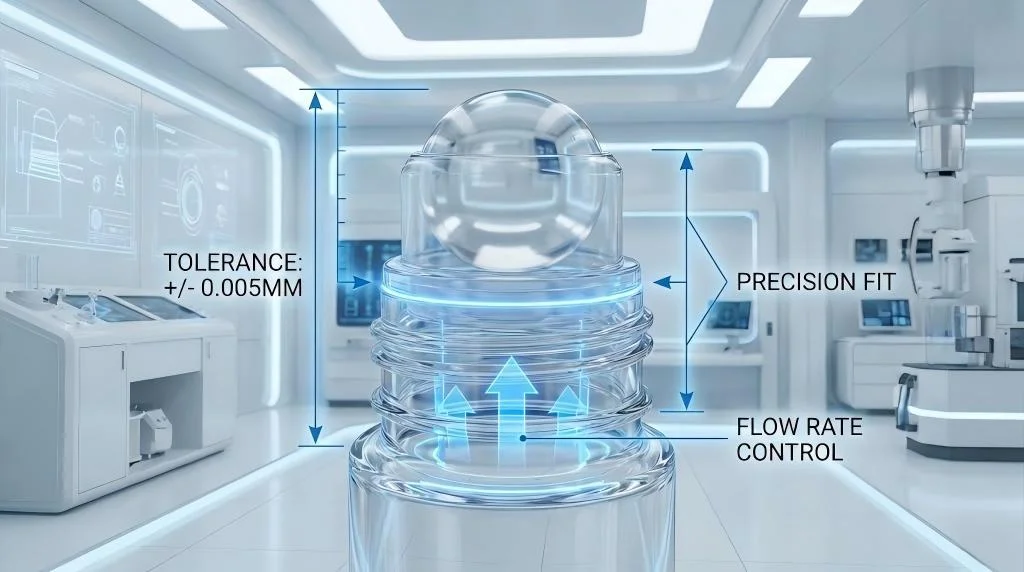
How to Choose the Right Ball for Your Formula Viscosity
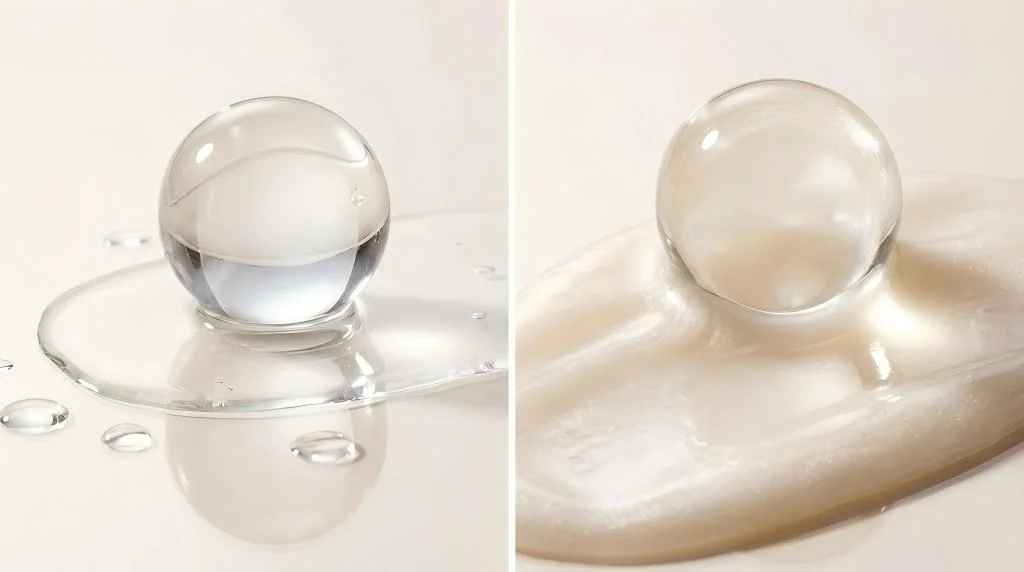
Ball selection is not purely a dimensional decision — formula viscosity directly affects which grade and diameter combination will perform correctly in your applicator housing.
Low-Viscosity Formulas (e.g., toners, mists, light serums — below ~50 cP)
Low-viscosity liquids flow easily but also leak easily. The ball-to-housing clearance must be minimized.
Specify tighter grade (G50 or better) to reduce clearance variation
Smaller diameters (? 6–9 mm) are common — confirm housing bore tolerance with your packaging supplier
Surface Ra ≤ 0.08 μm helps maintain a consistent fluid film without pooling
High-Viscosity Formulas (e.g., deodorant gels, thick creams — above ~500 cP)
Thick formulas require more rotational force to dispense. An overly tight fit causes under-dispensing.
G100 grade is typically sufficient — the formula's viscosity self-seals minor clearance gaps
Larger diameters (? 9–16 mm) provide more surface contact area for smooth application
Confirm ball weight: denser balls (higher g/cm3) can aid gravity-assisted dispensing in upright packaging
Transitional Viscosity (50–500 cP — most lotions, serums, roll-on deodorants)
This is the most common range and also the most sensitive to ball inconsistency.
G50 is the recommended default for new product development until housing tolerances are confirmed
Run a 500-unit assembly trial with your specified grade before committing to full production volume
Common Glass Ball Defects in Cosmetic Applications — And How We Control Them
This is where supplier selection makes a tangible difference. Beyond dimensional tolerance, cosmetic buyers should inspect and specify controls for the following:
Surface Defects
Chips & edge cracks (崩邊/裂紋): Caused by handling damage or forming process issues. Chips create sharp edges that damage applicator seals and pose skin safety risk. We inspect visually under magnification per agreed AQL.
Bubbles & inclusions (氣泡/夾雜): Internal voids in the glass matrix that weaken structural integrity and cause inconsistent weight. Specified as a reject criterion in our COA acceptance standard.
Black spots / surface contamination: Residue from forming or handling. Controlled through our documented cleaning and packaging process.
Cleanliness & Particulate Residue
Glass balls for cosmetic contact must be free of surface particles and residual processing media. We specify and document our cleaning process, and packaging is selected to prevent recontamination during transit.
Formula Compatibility (Long-Term Immersion)
For premium or leave-on formulas, we recommend requesting a compatibility soak test — immersing sample balls in your formula for 30–60 days and inspecting for surface etching, discoloration, or weight change. This is particularly important for formulas with pH < 4 or > 9.
Packaging & Transit Breakage
Glass balls are fragile in bulk. We use layered cushioning with inner separation to prevent ball-on-ball impact during shipping. Custom packaging configurations (e.g., trays, tubes) are available for high-precision grades where surface damage on transit is a rejection risk.
GMPC & ISO 22716: What These Certifications Mean for Your Supplier Qualification
The Industry Practice Behind Cosmetic Component Supplier Audits
FDA has issued cosmetic GMP guidance as non-binding recommendations, and there are no GMP regulations mandating compliance for cosmetic components. However, leading cosmetic brands and contract manufacturers routinely extend their supplier qualification requirements to component suppliers — including packaging balls — as a risk management and audit-readiness practice.
In practical terms, when your brand's quality team or a retailer audits your supply chain, they will ask:
Does your ball supplier have a documented quality system?
Can they provide traceability from finished product back to raw material?
Is there calibrated measurement equipment with records?
Are non-conforming products formally isolated and dispositioned?
These are standard deliverables in our GMPC and ISO 22716 certified production process — and we include them in every shipment as a documented pack, not on special request.
Our Certification Stack for Cosmetic Buyers
GMPC (US) 2022 — Cosmetic GMP standard aligned with U.S. market supplier qualification expectations
ISO 22716:2007 — International cosmetic GMP standard, accepted in EU, ASEAN, and most regulated markets
IATF 16949:2016 — Automotive quality management: mandates PPAP documentation, process control, and raw material traceability — the same disciplines that underpin our cosmetic QC rigour
Bureau Veritas (BV) Factory Inspection — Third-party facility audit available as supporting documentation for your supplier qualification file
QC Process: Our Audit-Ready Documentation Pack
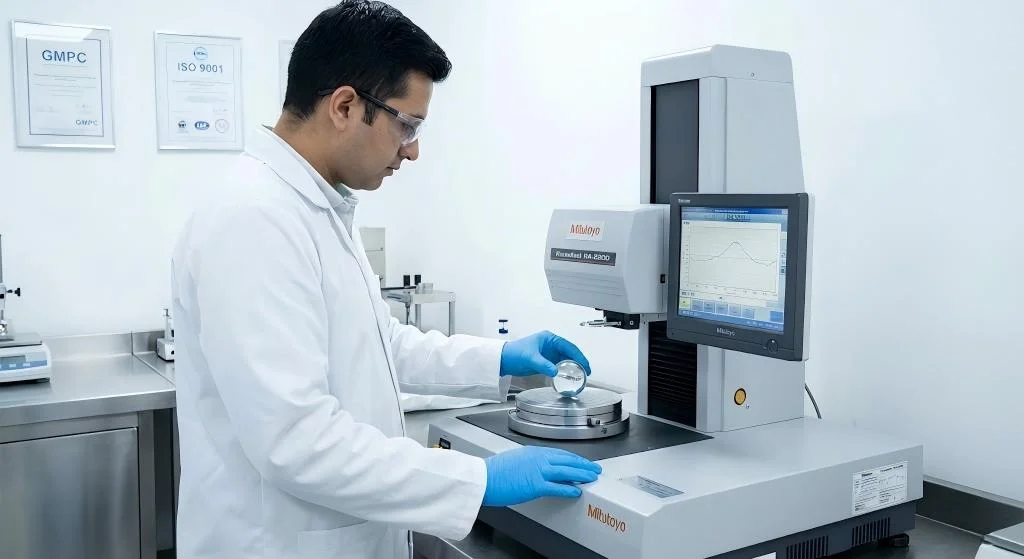
Our in-house quality laboratory is equipped specifically for ball inspection. Here is what we measure, how we measure it, and what we deliver:
What We Measure
Sphericity / Roundness (圓度儀): Measures form deviation — a ball correct in diameter but elliptical in form will still cause inconsistent dispensing and sealing. Measured instrumentally, not visually estimated.
Diameter / Dimensional tolerance: Verified against agreed grade specification per lot.
Surface Roughness (Ra): Quantified using calibrated profilometer. For G50 (Ra ≤ 0.08 μm) and above, measured per batch as standard.
Visual inspection: Chips, cracks, bubbles, black spots — inspected under magnification per agreed AQL level.
What Your COA Includes (Standard Fields)
Product description, nominal diameter, and agreed grade
Lot / batch number and production date
Measured diameter range (min / max / mean)
Measured sphericity deviation
Measured Ra value
Visual inspection result and AQL level applied
Equipment calibration reference numbers
Authorized signatory and issue date
Sampling Levels
| Application Risk | AQL Level | Recommended For |
|---|---|---|
| Standard / decorative | AQL 2.5 | Mass-market deodorant roll-ons |
| Cosmetic contact | AQL 1.0 | Skincare, eye-area applicators |
| Premium / sensitive skin | AQL 0.65 | Luxury facial, infant, dermatological |
Common Diameters for Cosmetic Glass Balls
Roll-on applicator glass balls are specified to match housing bore dimensions. The most common sizes we supply:
? 9.0 mm — Standard roll-on deodorant (most common globally)
? 11.0 mm — Large-format body roll-on
? 6.35 mm (?") — Precision serum and eye-area applicators
? 15.875 mm (?") — Luxury facial massage rollers
Custom diameters — Available; nominal diameter tolerance for custom sizes depends on the precision grade specified (G25 custom = tighter process control than G100 custom). Submit your housing bore drawing for a matched specification quote.
Note: For custom diameter orders, the achievable Dw (diameter variation) and roundness tolerance are grade-dependent — specifying G25 on a custom diameter means the same ± 6 μm Dw control applies, not a looser "custom" tolerance. Confirm your grade requirement alongside the nominal diameter in your RFQ.
Requesting a Quote: What to Include
To receive a precise quote without unnecessary back-and-forth:
Nominal diameter (mm or inch)
Precision grade (G10 / G25 / G50 / G100, or specify Dw + Ra directly)
Material (soda-lime / borosilicate)
Annual volume estimate (pieces or kg)
Formula type / viscosity range (helps us confirm grade recommendation)
Destination port and Incoterms preference
Documentation required (standard COA / full GMPC audit pack / BV inspection copy)
Quotes with complete specifications are returned within 24 business hours.
FAQ: Glass Balls for Cosmetics & Roll-On Applicators
Q1: Are your glass balls safe for direct skin contact in cosmetic applications?Yes. Our soda-lime glass balls are chemically inert and widely accepted in cosmetic packaging globally. We supply full per-lot traceability documentation and COA with every order, supporting your supplier qualification and safety assessment process.
Q2: What precision grade is standard for roll-on deodorant applicators?The industry standard for mass-market roll-on deodorants is G100 (diameter variation ± 25 μm, Ra ≤ 0.16 μm). Premium skincare and eye-area applicators typically require G50 or G25 for consistent dispensing and smooth skin contact.
Q3: Do you supply GMPC / ISO 22716 documentation for supplier qualification?Yes. We hold GMPC (US) 2022 and ISO 22716:2007 certifications at the facility level. Our standard shipment documentation includes COA, dimensional inspection report, and certification copies — no additional fee or special arrangement required.
Q4: What is the minimum order quantity for cosmetic glass balls?For standard diameters (? 6–16 mm, G50–G100), typical MOQ is 10,000 pieces. Custom diameters or G25/G10 grades may carry higher MOQs due to production batch requirements. Contact us to confirm for your specific diameter and grade combination.
Q5: Can glass balls withstand AHA/BHA or high-acid cosmetic formulas?Soda-lime glass performs well with most cosmetic formulas but may show surface changes with sustained exposure to pH < 4. For high-concentration AHA/BHA serums, we recommend borosilicate glass balls and suggest requesting a compatibility soak test before full production commitment.
Q6: How do I know the balls are free of chips, bubbles, or surface contamination?Visual inspection for chips, cracks, bubbles, and surface contamination is performed per agreed AQL level on every production batch. Results are documented in the COA. For applications requiring zero-defect surface quality (e.g., eye-area contact), we recommend specifying AQL 0.65 and requesting a pre-shipment inspection report.
Changzhou Eurasian Steel Ball Co., Ltd. — GMPC (US) 2022 | ISO 22716:2007 | IATF 16949:2016 | BV Certified Manufacturer
Audit-ready documentation. Precision to specification. Request your quote within 24 hours.


