


News


Wholesale Glass Balls: ISO-Certified Supplier for Optical & Industrial Applications
Our Role: Sourcing + Quality Verification + Delivery Responsibility
What we provide as your glass ball supply partner:
Qualified manufacturer sourcing: Direct relationships with ISO 9001/ISO 3290-certified glass sphere producers holding verified production capabilities
Incoming quality control: 100% dimensional inspection using calibrated metrology equipment (measurement reports provided with each shipment)
Material traceability: Full lot documentation from raw glass material through final inspection, including composition analysis certificates
Delivery assurance: Consolidated logistics and inventory management ensuring supply continuity
What we don't claim: We are not the direct manufacturer of glass spheres. Our value proposition is supply chain reliability, quality verification, and technical support for customers requiring traceable, certified glass ball products without managing multiple overseas suppliers.
Comprehensive Wholesale Glass Ball Product Range
Soda-Lime Glass Balls: Cost-Effective Volume Solutions
Material specifications (typical values - certificates available):
Density: 2.4 - 2.6 g/cm3 (per ASTM C693)
Hardness: 5.5 - 6.5 Mohs scale
Available precision grades: G100 - G500 (per ISO 3290-1:2014)
Diameter range: 1mm - 100mm
Common stock sizes: 3mm, 5mm, 6mm, 8mm, 10mm, 12mm, 15mm, 20mm
Primary applications:
Grinding and polishing media for surface finishing
Fluid mixing and agitation equipment
Flow control valve components in non-corrosive environments
Visual indicator and decorative applications
Our soda-lime glass balls deliver cost-effective performance for high-volume industrial applications where extreme chemical resistance is not required. We maintain established supply agreements with manufacturers capable of consistent monthly production, enabling competitive wholesale pricing with predictable lead times.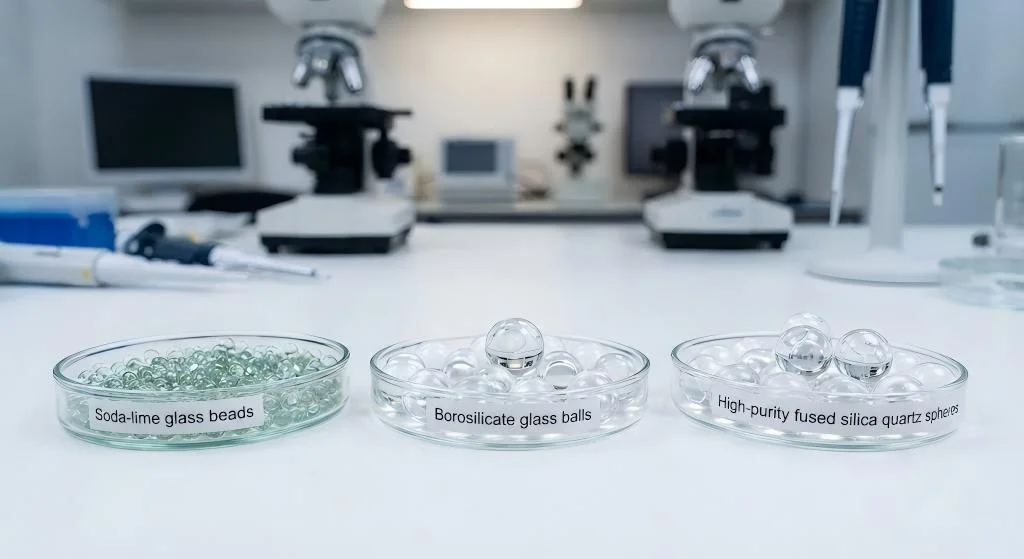
Borosilicate Glass Balls: Superior Thermal & Chemical Resistance
Material specifications (borosilicate 3.3 type - per manufacturer datasheet):
Density: ~2.2 g/cm3 (±0.05 g/cm3)
Hardness: 6 - 7 Mohs scale
Thermal expansion coefficient: 3.3 × 10??/K (20-300°C, similar to DURAN? standard)
Available precision grades: G10 - G200 (per ISO 3290-1:2014)
Diameter range: 0.5mm - 80mm
Common stock sizes: 1mm, 1.5mm, 2mm, 3mm, 4mm, 5mm, 6mm, 8mm, 10mm, 15mm, 20mm, 25mm
Key performance advantages:
Exceptional thermal shock resistance for rapid temperature cycling (validated to ΔT >150°C)
Chemical inertness against acids, alkalis, and organic solvents (chemical resistance data available)
Food-grade compliance potential (customer must verify specific material certificates for intended use)
Low thermal expansion minimizing dimensional changes across operating temperatures
Borosilicate glass spheres represent the optimal choice for laboratory equipment manufacturers and chemical processing valve suppliers. We can supply popular sizes with G10 precision per ISO 3290-1:2014 with full dimensional inspection reports showing actual measured values for diameter tolerance, batch diameter variation (Vdws), and sphericity deviation.
Quartz Glass Balls: Ultra-High Purity for Demanding Environments
Material specifications (fused silica type - manufacturer certified):
Density: ~2.2 g/cm3
Hardness: ~7 Mohs scale
Thermal expansion coefficient: ~0.5-0.6 × 10??/K (20-320°C range, varies by grade)
Maximum operating temperature: >1000°C (grade-dependent)
Available precision grades: G10 - G100 (per ISO 3290-1:2014)
Diameter range: 1mm - 60mm
Common stock sizes: 2mm, 3mm, 4mm, 5mm, 6mm, 8mm, 10mm
Critical application advantages:
Semiconductor manufacturing equipment requiring contamination-free components
High-purity chemical reactors where material leaching must be minimized
Extreme thermal cycling applications with temperature differentials exceeding 300°C
UV transmission optics in spectroscopy and analytical instrumentation
Our wholesale quartz glass ball supply includes materials comparable to JGS1/JGS2/JGS3 specifications. Material composition certificates and OH content analysis available upon request. For critical applications requiring specific material grades (Corning 7980/7971, etc.), we coordinate custom procurement with extended lead times.
Customized Glass Balls: Tailored Specifications
Beyond standard materials, we coordinate custom-manufactured glass spheres through our manufacturing partners:
Colored glass balls (black, blue, yellow, pink) for visual indication applications
Modified density formulations for specific gravity matching requirements
Custom diameter ranges outside standard inventory
Tighter tolerances (G5-G16 available with extended lead time and higher MOQ)
Custom specifications require technical feasibility review. Minimum order quantities typically start at 10,000-50,000 pieces depending on complexity. Lead times: 4-8 weeks after specification approval.
Precision Grade Standards: ISO 3290-1:2014 Reference
Standard specification basis: Our glass ball precision grades reference ISO 3290-1:2014 (Rolling bearings - Balls - Part 1: Steel balls) dimensional tolerances, adapted for non-metallic spheres. Customers specifying other standards (ABMA Std 10, DIN 5401, or GB/T 308) should indicate preferred standard at quotation stage for proper tolerance mapping.
Critical measurement parameters defined:
Nominal diameter tolerance (Dw): Deviation of actual diameter from specified nominal size
Batch diameter variation (Vdws): Difference between largest and smallest mean diameters within a production lot
Single ball diameter variation (Vdwl): Difference between largest and smallest diameters on a single sphere
Sphericity deviation: Maximum radial distance from true spherical form
Surface roughness (Ra): Arithmetic mean deviation of surface profile
| ISO Grade | Dw Tolerance | Vdws (Batch) | Vdwl (Single) | Sphericity | Ra Surface | Common Use Cases |
|---|---|---|---|---|---|---|
| G10 | ±2.5 μm | ≤0.5 μm | ≤0.25 μm | ≤0.25 μm | ≤0.025 μm | Optical coupling, precision valves |
| G16 | ±2.5 μm | ≤0.8 μm | ≤0.4 μm | ≤0.4 μm | ≤0.032 μm | Medical devices, sensors |
| G24 | ±2.5 μm | ≤1.2 μm | ≤0.6 μm | ≤0.6 μm | ≤0.05 μm | Industrial valve components |
| G48 | ±5.0 μm | ≤2.4 μm | ≤1.2 μm | ≤1.2 μm | ≤0.08 μm | Grinding media, mechanical systems |
| G100 | ±12.5 μm | ≤5.0 μm | ≤2.5 μm | ≤2.5 μm | ≤0.125 μm | General industrial applications |
| G200 | ±25.0 μm | ≤10.0 μm | ≤5.0 μm | ≤5.0 μm | ≤0.20 μm | Low-precision fluid control |
| G500 | ±50.0 μm | ≤25.0 μm | ≤13.0 μm | ≤13.0 μm | - | Mixing, agitation media |
Important notes:
Tolerances shown are typical for ISO 3290 Grade designations. Actual delivered specifications confirmed via dimensional inspection report provided with each lot.
Glass material properties (thermal expansion, chemical resistance) may affect achievable precision compared to steel ball reference standards.
Surface quality notation: When specified, we reference MIL-PRF-13830B scratch/dig (S/D) classification using 10× magnification inspection under standardized lighting conditions. Common grades: 10/5 (optical), 20/10 (precision industrial), 40/20 (general use).
Quality Verification: Documentation & Traceability
Inspection Capabilities & Documentation
Our quality control process provides the following documentation with each order:
Standard with every shipment:
Dimensional Inspection Report showing actual measured values for:
Mean diameter (Dw) and tolerance compliance
Batch diameter variation (Vdws)
Sample-based sphericity and surface roughness measurements
Inspection equipment identification and calibration status
Available upon request (may require advance notice):
Material Composition Certificate from raw material supplier (chemical analysis)
Material Safety Data Sheet (MSDS) for handling and disposal information
Traceability documentation linking finished spheres to raw glass lot numbers
For regulatory-sensitive applications:
Third-party testing coordination (customer-specified laboratory, additional cost and lead time)
Custom test protocol execution (specific dimensional sampling plans, environmental exposure testing)
Manufacturing Partner Qualification
We maintain supply relationships with glass sphere manufacturers meeting the following criteria:
ISO 9001:2015 quality management system certification (certificate copies available)
Demonstrated precision grinding capability with documented measurement system analysis
Material sourcing from certified glass suppliers with composition control
Production equipment including multi-stage grinding, lapping, and polishing systems suitable for achieving specified tolerances
Our incoming quality control includes:
Statistical sampling inspection per ANSI/ASQ Z1.4 (AQL-based acceptance)
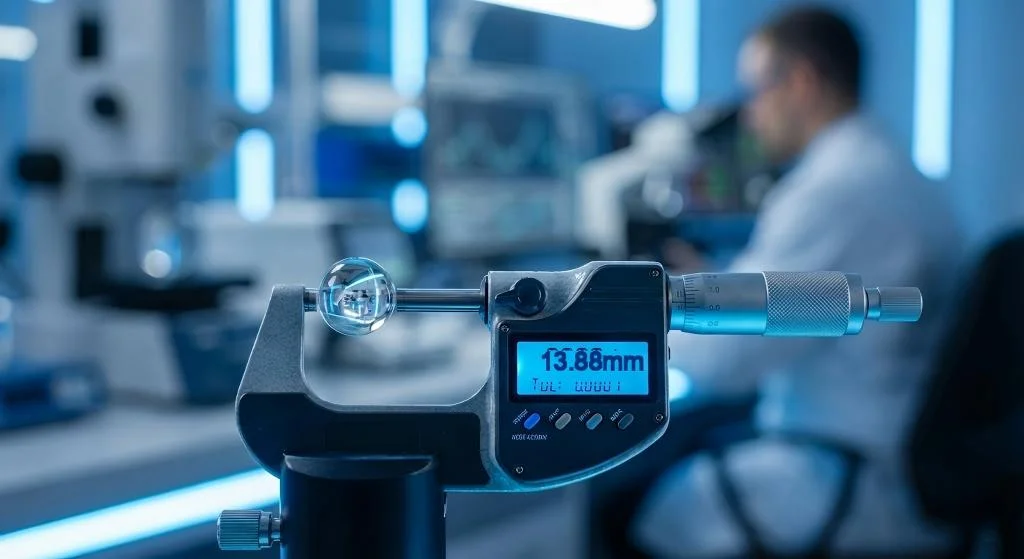
Dimensional verification using calibrated measurement equipment (roundness testers, micrometers)
Visual inspection for surface defects per agreed S/D criteria
Lot documentation review ensuring traceability compliance
Wholesale Pricing & Order Terms
Volume-Based Pricing Structure
Our pricing reflects material type, precision grade, quantity, and delivery urgency. Typical pricing framework:
Minimum order quantities:
Standard stock sizes (G100-G200): 1,000 pieces minimum per size/grade
Precision grades (G10-G48): 5,000 pieces minimum per specification
Custom specifications: 10,000-50,000 pieces depending on complexity
Volume discounts available:
Orders exceeding 50,000 pieces per specification
Blanket purchase orders with scheduled releases (committed annual volume >200,000 pieces)
Consignment inventory programs for qualified high-volume customers
Pricing valid factors:
Material type (soda-lime < borosilicate < quartz in cost hierarchy)
Precision grade (tighter tolerances increase cost exponentially below G24)
Diameter size (very small <2mm or large >50mm command premiums)
Delivery timeline (standard lead time vs. expedited production)
Lead Times & Delivery
Stock items (common sizes, G100-G200):
Soda-lime and borosilicate: 5-10 business days from order confirmation
Quartz: 10-15 business days (more limited stock availability)
Non-stock standard specifications:
Precision grades G10-G48: 4-6 weeks manufacturing + shipping
Custom sizes or materials: 6-10 weeks after specification approval
Expedited service considerations:
Rush production possible for established customers with existing specifications
Expedited manufacturing requires minimum 20% premium and feasibility confirmation
Typical expedited lead time reduction: 30-40% off standard timeline where manufacturer capacity permits
Shipping options:
Express air freight: 5-7 days worldwide (recommended for small quantities, precision grades)
Standard air freight: 10-14 days (cost-effective for medium volumes)
Sea freight: 4-6 weeks (economical for bulk orders >25kg)
Technical Support & Application Assistance
Our technical team provides support for glass ball specification development:
Pre-Purchase Consultation
Material selection guidance for chemical/thermal environment compatibility
Precision grade recommendations balancing functional requirements and cost
Tolerance analysis for assembly designs (stack-up calculations)
Sample Programs
Evaluation samples available: Small quantities (100-500 pieces) at standard unit pricing for performance validation testing
Sample testing: We can coordinate dimensional verification at customer-specified third-party laboratories (additional cost)
Application-Specific Information
Chemical resistance data: Available for common acids, bases, solvents, and cleaning agents
Thermal performance parameters: Thermal expansion, maximum operating temperature, thermal shock resistance
Regulatory compliance support: Assistance compiling material documentation for FDA, RoHS, REACH, or other regulatory submissions (customer responsible for final compliance determination)
Industry Applications
Optical & Fiber Optic Systems
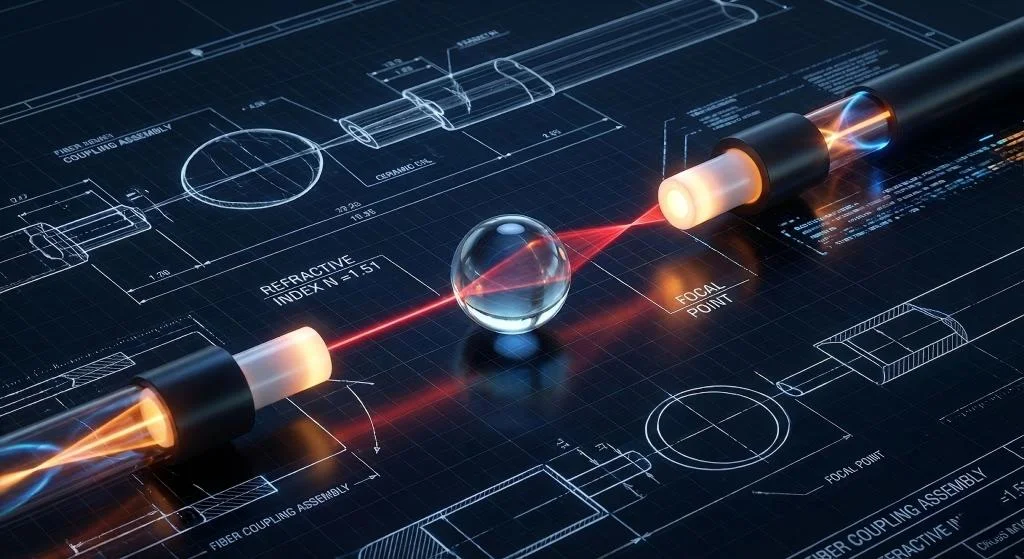
Precision glass balls in G10-G24 grades serve fiber coupling components including:
Fiber collimators and beam expanders
Optical switch matrices
Laser-to-fiber coupling assemblies
Endoscope lens systems
Material preference: Borosilicate or quartz for refractive index consistency and thermal stability
Laboratory & Scientific Equipment
Precision glass spheres function in:
Chemical reactor mixing and flow distribution (borosilicate for chemical resistance)
Chromatography column packing (uniform sphere sizing critical)
Thermal analysis reference standards (quartz for thermal stability)
Microfluidic device components (small diameter precision spheres)
Medical Device Components
Glass spheres for medical applications require careful material selection and documentation:
Drug delivery valve mechanisms (material biocompatibility assessment needed)
Diagnostic equipment sealing systems (cleanroom packaging available)
Pharmaceutical packaging components (customer validates food/drug contact compliance)
Documentation support: We provide material composition certificates and MSDS for regulatory submissions. Customer responsible for biocompatibility testing and final device approval.
Industrial Fluid Control
Industrial-grade glass balls in cost-effective grades:
Water treatment valve check balls (soda-lime or borosilicate)
Chemical dosing systems (borosilicate for corrosion resistance)
Pneumatic controls (lightweight, non-magnetic properties)
Food processing equipment (customer verifies food-contact material compliance)
Why Choose Changzhou Eurasian Steel Ball as Your Supply Partner
Supply Chain Management Expertise
Our value proposition centers on reliable sourcing and quality assurance:
Established manufacturer relationships with ISO-certified glass sphere producers
Quality control infrastructure including incoming inspection and dimensional verification
Consolidated logistics simplifying procurement from overseas suppliers
Technical documentation support compiling certificates and test reports
Customer Service Commitment
Responsive quotation turnaround (24-48 hours for standard specifications)
Flexible order terms accommodating prototype through production volumes where MOQs permit
Transparent communication on lead times, quality issues, and specification limitations
Important Service Boundaries
What we guarantee:
Dimensional compliance to specified tolerances (verified by our incoming inspection)
Complete traceability documentation from manufacturer
On-time delivery per confirmed lead times
Responsive technical support for specification questions
What requires customer validation:
Material suitability for specific application environments (we provide data, customer decides)
Regulatory compliance for end-use applications (we supply documentation, customer owns approval)
Application performance testing (we can coordinate sample programs, customer validates function)
Ordering Process
Step 1: Specification Definition
Provide the following information:
Material type (soda-lime, borosilicate, quartz)
Nominal diameter and required precision grade (or specific tolerance requirements)
Quantity required
Delivery timeline
Special requirements (surface quality, packaging, documentation)
Step 2: Quotation & Feasibility Review
Quote delivery: 24-48 hours for standard specifications
Technical review: We validate specification feasibility with manufacturing partners
Sample availability: Evaluation samples can be quoted for orders with >5,000 piece commitment
Step 3: Order Confirmation & Production
Pro forma invoice with confirmed specifications, pricing, and lead time
Manufacturing coordination with supplier including specification review
Production updates provided at key milestones for large orders
Step 4: Quality Control & Shipment
Incoming inspection upon arrival at our facility
Dimensional verification against specification requirements
Documentation compilation (inspection report, certificates, packing list)
Shipment arrangement per customer's preferred logistics method
Contact & Resources
Ready to discuss your glass sphere requirements?
Changzhou Eurasian Steel Ball Co., Ltd
Email: [Your company email - update from grind-techs.com domain shown in provided materials]
Phone: [Your contact phone number]
Technical inquiries: Provide your specification details for quotation and feasibility assessment.
Documentation requests:
Sample dimensional inspection report format
Typical material certificate example
IATF 16949:2016 certificate (scope of certification available upon request)
Frequently Asked Questions (FAQ)
Q1: What precision grade should I specify for optical fiber coupling applications?
Optical fiber coupling applications typically require G10 or G16 precision per ISO 3290-1 to achieve consistent coupling efficiency across manufactured units. The critical parameter is batch diameter variation (Vdws) ≤0.5-0.8 μm ensuring all spheres in your production lot maintain nearly identical focal lengths. Material selection between borosilicate and quartz depends on your refractive index requirements and thermal environment—we can provide refractive index data from manufacturer datasheets to support your optical design. For cost optimization, specify the maximum acceptable Vdws tolerance for your coupling efficiency target rather than defaulting to tightest available grade.
Q2: Can I receive sample dimensional inspection reports before placing a large order?
Yes, we can provide sample inspection report formats showing the measurement parameters we document (mean diameter, Vdws, Vdwl, sphericity, surface roughness) and our inspection methodology. For evaluation of actual product quality, we offer evaluation sample quantities (100-500 pieces) at standard pricing for customers with committed order intent exceeding 5,000 pieces. If you require third-party dimensional verification, we can coordinate testing at your specified laboratory (additional cost and 2-3 week lead time). The inspection report accompanies every production shipment, providing full traceability of dimensional compliance.
Q3: How do I know if borosilicate or quartz glass is required for my chemical environment?
Borosilicate glass (3.3 type) offers excellent resistance to most acids (except HF), bases, and organic solvents for temperatures up to 400-500°C, making it suitable for most laboratory and industrial chemical applications. Quartz glass provides superior chemical inertness and can operate above 1000°C, but costs 2-4× more than borosilicate. We can provide manufacturer chemical resistance data showing degradation rates in common reagents. For critical or undefined chemical exposures, we recommend requesting material samples for customer-conducted immersion testing in your actual process fluids. Our technical team can review your chemical exposure conditions and provide material selection guidance, but final material suitability determination remains customer's responsibility.
Q4: What is the minimum order quantity for custom glass ball diameters?
Minimum order quantities for custom diameters depend on size and precision requirements. Standard precision grades (G100-G200) in custom sizes typically require 10,000-25,000 piece minimums due to manufacturing setup costs. Tighter precision grades (G10-G48) or very small diameters (<2mm) may require 50,000+ piece minimums. Lead times for custom sizes: 6-10 weeks after specification approval. If your required diameter is within ±10% of a standard stock size, we may be able to supply by selecting within-specification spheres from broader tolerance production runs—contact us to explore options before committing to full custom production.
Q5: What surface quality (S/D rating) do I need for my valve application?
Surface quality requirements depend on your sealing pressure and leak rate specifications. 20/10 scratch/dig per MIL-PRF-13830B suffices for most industrial valve applications with face-to-seat sealing pressures up to 1000 psi. 10/5 surface quality is typically specified only for optical applications or ultra-high-pressure sealing (>2000 psi) where surface imperfections could initiate stress fractures. Each improvement in surface quality increases cost due to additional polishing cycles—we recommend specifying the minimum acceptable S/D rating meeting your functional requirements rather than over-specifying optical-grade finish for non-optical applications. We can provide surface quality inspection methodology details to support your specification development.
Q6: Can you provide FDA compliance documentation for food-contact applications?
We can supply material composition certificates and MSDS from glass manufacturers, which serve as supporting documentation for your FDA compliance assessment. However, determination of food-contact compliance remains customer's responsibility as it depends on your specific application conditions (contact time, temperature, pH, food type) and applicable regulations (21 CFR 177 for indirect food contact). For borosilicate and soda-lime glass materials, relevant composition data and leachable testing protocols are available. We recommend consulting with your regulatory affairs team early in specification development to identify required testing and documentation. We can coordinate custom material testing at third-party laboratories if needed (additional cost and lead time).
Q7: How is lot traceability maintained from raw material to finished sphere?
Each production lot receives a unique lot identification number linking to manufacturer production records. Documentation available with each shipment includes: (1) Dimensional inspection report with lot ID and measurement data, (2) Material certificate from raw glass supplier showing composition analysis and lot number, (3) Manufacturing traceability document linking finished sphere lot to raw material lot. This documentation allows backward traceability to raw glass ingot in case of quality issues or recall requirements. For customers requiring enhanced traceability (aerospace, medical device), we can coordinate additional documentation from manufacturers including process parameter records, though this may extend lead times 5-7 business days for document compilation.
Q8: What packaging prevents glass sphere damage during international shipping?
Our standard packaging utilizes vacuum-sealed polyethylene bags with desiccant inside rigid plastic containers, providing moisture protection and cushioning against typical shipping vibration. For precision grades G24 and tighter, we upgrade to double-bag packaging with foam cushioning layers minimizing sphere-to-sphere contact. For customers requiring cleanroom-grade packaging, we can coordinate packaging in Class 100 environment conditions (additional cost). Very high-value ultra-precision orders can use custom foam insert trays eliminating all sphere contact during transit. Packaging selection should balance protection requirements with cost—most G48-G200 grade orders ship successfully in standard packaging. Contact us if your application has specific contamination or handling sensitivities requiring specialized packaging.
Q9: Can production lead times be expedited for urgent requirements?
For in-stock items (common sizes, G100-G200 grades), we can ship within 5-7 business days via express courier. For non-stock specifications, expedited production depends on manufacturer capacity availability and may require 15-20% pricing premium. Typical expedited lead time: 3-4 weeks instead of standard 4-6 weeks for precision grades. Important limitation: Very tight tolerance specifications (G10-G16) or custom materials require full manufacturing cycles and cannot be substantially accelerated due to multi-stage grinding/polishing processes. To avoid urgency premiums, we recommend establishing blanket purchase orders with scheduled releases for predictable consumption items. Contact us immediately if facing production-down scenarios—we prioritize emergency support for established customers.
Q10: What technical support is available for glass ball material selection?
Our applications team provides complimentary pre-purchase consultation including: (1) Chemical/thermal compatibility assessment for your operating environment using manufacturer material data, (2) Precision grade recommendations balancing functional requirements and cost based on your application tolerances, (3) Tolerance stack-up review for assembly designs. For complex applications, we can coordinate sample testing programs where you receive evaluation quantities for functional validation testing. Our goal is helping you specify the optimal glass ball solution meeting functional requirements at lowest total cost. However, final material suitability determination remains customer's responsibility—we provide technical data and guidance, but cannot guarantee application performance without customer validation testing. Contact us early in your design process for maximum value-engineering opportunity.


