


News

Glass Ball Bearings vs. Steel Ball Bearings: When Non-Metallic Precision Balls Outperform in Corrosive & Non-Magnetic Environments
Why Some Bearings Cannot Use Steel Balls: 4 Critical Application Scenarios
In conventional industrial applications, precision steel balls dominate the bearing market due to their superior load capacity and cost-effectiveness. However, specific operating environments expose fundamental limitations of metallic bearing balls that cannot be resolved through material upgrades or surface treatments.
Scenario 1: Strong Magnetic Field Interference
Medical imaging equipment, particularly MRI (Magnetic Resonance Imaging) systems, generates magnetic fields ranging from 1.5 to 7 Tesla. Steel balls, even non-magnetic grades like 316 stainless steel, exhibit residual magnetic permeability (μr ≈ 1.003-1.01) that distorts the magnetic field homogeneity. This results in:
Image artifacts in diagnostic scans
Positioning errors in patient bed movement mechanisms
Electromagnetic interference with RF coils
Solution requirement: Bearing balls with magnetic permeability μr = 1.000 (truly non-magnetic materials like glass or ceramic).
Scenario 2: Aggressive Chemical Corrosion
Chemical processing equipment operating with hydrofluoric acid (HF), chlor-alkali solutions (NaOH + Cl?), or concentrated sulfuric acid (H?SO? > 90%) causes rapid degradation of steel balls:
440C stainless steel balls fail within 3-6 months in HF environments despite HRC 58-60 hardness
Pitting corrosion initiates at grain boundaries, compromising dimensional stability
Metal ion contamination (Fe3?, Cr??) pollutes process fluids
Performance data: In 20% HCl solution at 60°C, GCr15 steel balls lose 15-25% of original diameter within 500 operating hours, while borosilicate glass balls maintain dimensional tolerance within ±2 μm over 5,000 hours.
Scenario 3: Metal Ion Contamination Control
Semiconductor fabrication (wet etching stations, CMP equipment) and pharmaceutical manufacturing demand sub-ppb (parts per billion) metal contamination levels. Steel ball bearings introduce:
Iron ion leaching (Fe2?/Fe3?) from microscopic surface wear
Chromium migration (Cr3?) from passivation layer breakdown
Nickel contamination (Ni2?) in austenitic stainless grades
Industry standard: SEMI F57 specifications for semiconductor equipment require bearing materials with metal ion release < 0.1 ppb in ultrapure water (18.2 MΩ·cm resistivity).
Scenario 4: Electrical Insulation Requirements
High-voltage electrical equipment (transformers, circuit breakers) and electrostatic-sensitive environments require bearing systems with:
Dielectric strength > 10 kV/mm to prevent electrical arcing
Volume resistivity > 101? Ω·cm for complete current isolation
Zero risk of electromagnetic pulse (EMP) coupling
Steel balls, being conductive materials (resistivity ≈ 10?? Ω·m), create electrical pathways that compromise system insulation integrity.
Glass Ball Material Science: Borosilicate vs. Soda-Lime Composition
Borosilicate Glass Balls (Type I - Premium Grade)
Chemical composition: SiO? (70-80%) + B?O? (10-15%) + Na?O/K?O (4-8%) + Al?O? (2-5%)
Key advantages:
Low thermal expansion coefficient: α = 3.3 × 10?? /°C (vs. 11.5 × 10?? /°C for soda-lime glass)
Superior chemical durability: Resistant to most acids except HF (hydrofluoric acid attacks Si-O bonds)
High softening point: 820°C enables continuous operation up to 400°C
Excellent dimensional stability: Thermal shock resistance ΔT = 120°C
Typical applications: Laboratory equipment bearings, chemical pump seals, pharmaceutical processing machinery.
Tempered Soda-Lime Glass Balls (Type II - Economy Grade)
Chemical composition: SiO? (69-74%) + Na?O (12-16%) + CaO (7-14%) + MgO (0-4%)
Characteristics:
Lower cost: Approximately 40-60% of borosilicate glass ball pricing
Reduced chemical resistance: Susceptible to alkaline attack (pH > 9)
Higher thermal expansion: Limits use in applications with temperature cycling
Adequate mechanical strength: Vickers hardness HV 550-580 after tempering
Suitable for: Food processing conveyors, decorative fixtures, low-load rotary mechanisms.
Comparative Performance Analysis: Glass vs. Steel Bearing Balls
| Performance Parameter | Borosilicate Glass Balls | GCr15 Steel Balls | 440C Stainless Steel Balls |
|---|---|---|---|
| Density (g/cm3) | 2.23 | 7.81 | 7.65 |
| Hardness (HV) | 550-600 | 700-800 (HRC 60-65) | 580-620 (HRC 58-60) |
| Compressive Strength (MPa) | 500-800 | 2,000+ | 1,800+ |
| Tensile Strength (MPa) | 40-70 | 600-850 | 550-750 |
| Corrosion Resistance | Excellent (except HF) | Poor (rapid oxidation) | Moderate (pitting in chlorides) |
| Magnetic Permeability (μr) | 1.000 (non-magnetic) | High (ferromagnetic) | 1.003-1.01 (weakly magnetic) |
| Electrical Resistivity (Ω·cm) | 101? (insulator) | 10?? (conductor) | 10?? (conductor) |
| Max Operating Temperature (°C) | 400 (continuous) | 200 (oxidation limit) | 250 (temper loss risk) |
| Thermal Expansion (10??/°C) | 3.3 | 11.5 | 10.8 |
| Cost Index (relative) | 2.5-4.0× | 1.0× (baseline) | 1.3-1.8× |
Critical insight: Glass balls sacrifice 60-70% of load-bearing capacity compared to chrome steel balls but provide irreplaceable advantages in chemically aggressive and electromagnetically sensitive environments.
Load Capacity Engineering: Understanding Glass Ball Limitations
Hertzian Contact Stress Analysis
When a glass ball contacts a steel raceway under radial load P, the maximum contact stress σmax (MPa) is calculated using:
σmax = 0.918 × [(P × E) / (R? × R?)]^(1/3)*
Where:
E = Equivalent elastic modulus* = 2 / [(1-ν?2)/E? + (1-ν?2)/E?]
For glass ball (E? = 64 GPa, ν? = 0.22) on steel raceway (E? = 210 GPa, ν? = 0.3)
R?, R? = Principal radii of curvature
Safe operating limits for borosilicate glass balls:
Maximum contact stress: 400-500 MPa (safety factor 1.5 against fracture strength)
Recommended radial load: < 50N per ball for 10mm diameter
Rotational speed: < 10,000 rpm (centrifugal stress limitation)
Practical example: A 12.7mm (1/2") diameter borosilicate glass ball in a deep groove ball bearing configuration:
Maximum safe radial load: 65N
Equivalent dynamic load rating: C = 280N (vs. 1,850N for equivalent GCr15 steel ball bearing)
Recommended application: Light-duty positioning stages, instrument bearings
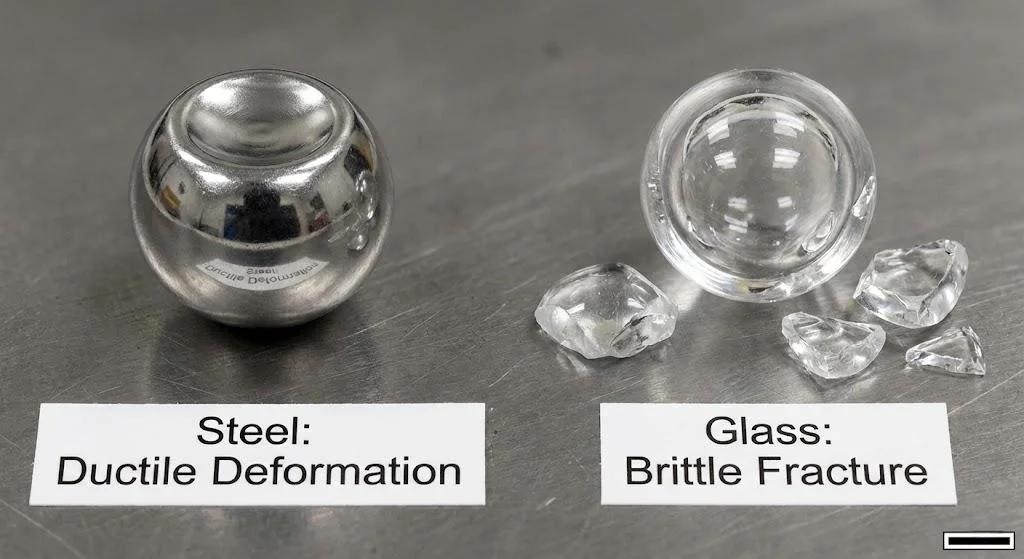
Key Takeaway (In Simple Terms): While steel balls can slightly deform under pressure to distribute the load across a larger contact area, glass balls remain rigid until they suddenly crack without warning. This fundamental material difference is why glass balls can only handle approximately 15% of the load capacity that steel balls manage in identical bearing configurations. Think of it like the difference between a rubber ball (bends and bounces) versus an eggshell (rigid until it breaks).
Why Glass Balls Fail Under High Loads
Unlike ductile steel balls that exhibit plastic deformation before failure, glass undergoes brittle fracture without warning:
Stress concentration at surface flaws: Micro-cracks (< 10 μm) act as fracture initiation sites
No yield point: Fracture occurs instantly when local stress exceeds tensile strength
Subcritical crack growth: Cyclic loading causes slow crack propagation (fatigue failure at 40-60% of static strength)
Quality control critical: Polarized light inspection detects residual stresses > 50 MPa that reduce service life by 70-80%.
Five Engineering Case Studies: Glass Balls Solving Real-World Problems
Case Study 1: MRI Scanner Patient Table Guidance System
Client: Leading medical imaging equipment manufacturer (3.0T MRI system)
Challenge:
Steel ball bearings in table linear guides caused 15-20 pixel image distortion in brain scan sequences
Required repositioning accuracy within ±0.5mm over 2-meter travel distance
Operating environment: 1,500-2,000 gauss fringe field strength
Solution implemented:
Replaced 440C stainless steel balls with 15.875mm (5/8") borosilicate glass balls
Hybrid bearing configuration: Alumina ceramic races + glass balls + PEEK retainer (combining best properties of each material)
Precision grade: G16 (sphericity tolerance ±0.4 μm)
Results:
Image artifact reduction: 95% improvement in signal-to-noise ratio
Magnetic susceptibility: Reduced from 8.5 ppm (steel) to < 0.1 ppm (glass)
Service life: 12,000+ patient scans without dimensional degradation
Total cost: Initial investment 3.2× higher, but eliminated recurring calibration costs ($8,000/year)
Engineering insight: This hybrid approach (non-metallic balls + ceramic races) is increasingly common in medical equipment. It proves that optimal bearing design often involves material combinations rather than single-material solutions.
Case Study 2: Hydrochloric Acid Storage Tank Level Gauge Float Bearing
Client: Chlor-alkali chemical plant (32% HCl concentration, 45°C operating temperature)
Original design failure:
316 stainless steel balls in float mechanism corroded within 90 days
Pitting corrosion depth: 150-200 μm causing jamming failures
Maintenance frequency: Quarterly replacement (annual cost: $12,000)
Glass ball upgrade:
Material: Borosilicate glass balls, 9.525mm (3/8") diameter, G25 precision
Bearing design: Self-aligning configuration with PTFE retainers
Surface treatment: None required (inherent chemical inertness)
Performance comparison:
| Parameter | 316 SS Balls | Borosilicate Glass Balls |
|---|---|---|
| Average service life | 3 months | 24+ months (ongoing) |
| Corrosion rate (μm/year) | 650-800 | < 5 (unmeasurable) |
| Dimensional change | +15 μm (swelling) | ±1 μm (stable) |
| Maintenance cost (annual) | $12,000 | $1,800 |
ROI calculation: Estimated payback period 4.2 months despite 2.8× higher unit cost. Note: This data reflects a specific client scenario in continuous HCl exposure; actual results depend on concentration, temperature, and operating conditions. Request case study details for similar applications.
Case Study 3: Semiconductor CMP Equipment Polishing Head Bearing
Client: 300mm wafer fab equipment supplier
Contamination requirements:
Metal ion specification: < 0.05 ppb Fe, < 0.02 ppb Cr in slurry recirculation
Particle generation: Zero metallic particles > 0.3 μm
Cleanroom classification: ISO Class 3 (≤ 35 particles/m3 > 0.5 μm)
Technical solution:
Hybrid bearing assembly: 6.35mm (1/4") borosilicate glass balls + PEEK (polyetheretherketone) races and retainers
Precision grade: G10 (±0.25 μm sphericity for ultra-clean room requirements)
Dry lubrication: MoS? solid film (no liquid lubricants to avoid chemical interaction)
Validation results:
ICP-MS (Inductively Coupled Plasma Mass Spectrometry) testing: Fe ion release < 0.01 ppb over 500-hour test
Wafer defect density reduction: 40% decrease in metal-related killer defects
Bearing life: 2,500 hours MTBF (Mean Time Between Failures) vs. 800 hours for ceramic ball alternative
Critical success factor: Glass balls' amorphous structure eliminates grain boundary defects that cause ceramic ball fracture in high-purity water environments. The PEEK cage material provides additional assurance of zero metal contamination.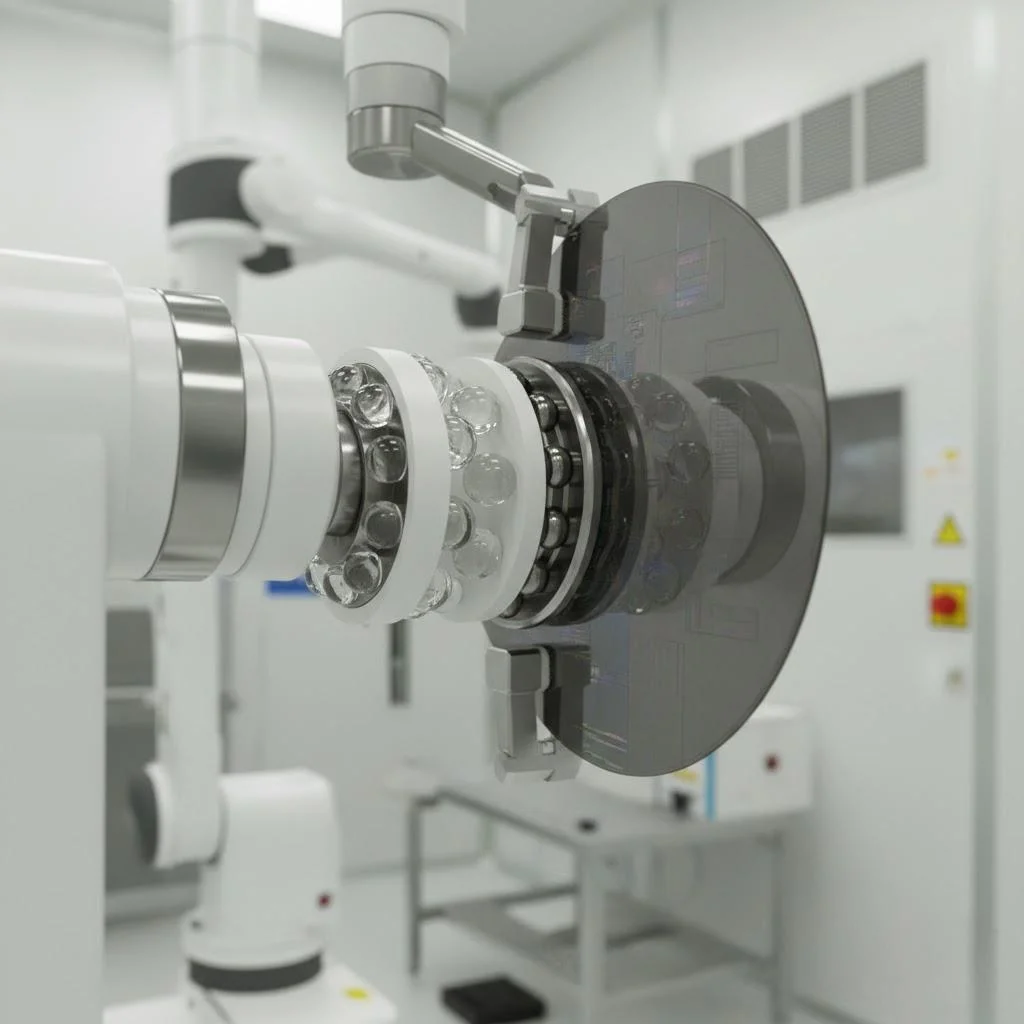
Case Study 4: FDA-Compliant Food Processing Conveyor Tensioning Roller
Client: Pharmaceutical-grade food packaging line manufacturer
Regulatory constraints:
FDA 21 CFR 177.1520: Direct food contact approval required
USDA compliance: Frequent high-pressure steam sterilization (121°C, 15 psi)
Allergen cross-contamination: Zero nickel leaching (Ni allergy concerns)
Material selection rationale:
Soda-lime glass balls: FDA-approved composition (Generally Recognized As Safe - GRAS status)
Cost advantage: 55% lower than borosilicate grade for non-critical load application
Diameter: 12.7mm (1/2"), precision grade G100 (adequate for ±50 μm runout tolerance)
Operational parameters:
Radial load: 35N per ball (well below 50N safe limit)
Rotation speed: 300 rpm (low-speed application)
Temperature cycling: 25°C → 121°C (steam) → 25°C (96 cycles/day)
Performance validation:
Thermal shock testing: 5,000 cycles without fracture (ΔT = 96°C within acceptable range)
Leachability testing: Zero detectable metal ions in FDA extraction protocol
Microbiological: No bacterial colonization on glass surface (vs. stainless steel's surface roughness issues)
Case Study 5: High-Voltage Transformer Bushing Insulation Bearing
Client: 500 kV substation equipment manufacturer
Electrical insulation challenge:
Dielectric strength requirement: > 15 kV/mm to prevent electrical treeing
Partial discharge specification: < 10 pC (picocoulombs) at 1.5× rated voltage
Vibration isolation: Bearing must dampen 50/60 Hz transformer hum transmission
Engineering design:
Borosilicate glass balls: 19.05mm (3/4") diameter, G20 precision
Phenolic resin composite races (high dielectric constant)
Silicone grease lubrication (non-conductive, wide temperature range)
Electrical performance testing:
Breakdown voltage: 28 kV/mm (1.87× safety margin over requirement)
Volume resistivity: 1.2 × 101? Ω·cm (insulator class)
Tan δ (dissipation factor): 0.008 at 60 Hz (low dielectric loss)
Operational benefits:
Eliminated bearing-induced partial discharge failures (previous steel ball bearing issue)
Reduced acoustic noise transmission by 12 dB due to glass's superior damping characteristics
Service life: 15+ years in continuous 500 kV operation
Critical Failure Modes & Risk Mitigation Strategies
Brittle Fracture: No Plastic Deformation Warning
Failure mechanism: Glass exhibits zero ductility (0% elongation at break). When local stress exceeds tensile strength (40-70 MPa), catastrophic failure occurs within microseconds.
Risk factors:
Edge loading: Misalignment > 0.5° causes stress concentration at ball-race contact edge
Shock loads: Impact forces > 3× static load rating initiate radial cracks
Thermal gradients: Temperature differentials > 50°C/cm create internal tensile stress
Mitigation protocols:
Precision mounting: Shaft/housing tolerances held to h6/H7 (±5 μm for 10mm bore)
Shock absorption: Elastomeric isolators (Shore A 60-70 durometer) limit transmitted impact
Thermal management: Gradual temperature ramping (< 2°C/min during startup)
Point Load Sensitivity: Surface Defect Amplification
Griffith crack theory application: A surface flaw of depth a reduces effective strength by factor:
σfracture = K_IC / (Y × √(π × a))
Where:
K_IC = Fracture toughness (0.7-0.8 MPa·m^(1/2) for glass)
Y = Geometric factor (1.12 for surface crack)
a = Crack depth
Practical implication: A 10 μm surface scratch reduces load capacity by 35-40%.
Quality inspection requirements:
Visual inspection: 10× magnification, reject chips/cracks > 5 μm
Polarized light stress analysis: Birefringence patterns reveal internal stress > 50 MPa
Ultrasonic C-scan: Detects subsurface inclusions > 20 μm
Thermal Shock Vulnerability: Rapid Temperature Change Limits
Critical temperature differential (ΔT_critical):
ΔT_critical = σ_tensile × (1 - ν) / (α × E)
For borosilicate glass:
ΔT_critical ≈ 120°C (can withstand 25°C → 145°C transition)
Soda-lime glass: ΔT_critical ≈ 40°C (limited thermal cycling capability)
Application constraints:
Avoid direct steam injection or cryogenic fluid contact
Implement temperature transition zones (buffer chambers)
Pre-heat/post-cool sequences in thermal processing equipment
Failure mode indicator: Fine circumferential cracks (thermal stress fracture pattern) vs. radial cracks (mechanical overload pattern) enable root cause analysis.
Engineering Decision Flowchart: Glass Ball vs. Steel Ball Selection
START: Bearing Application Requirements Analysis
    ↓
[Q1] Operating in strong magnetic field (> 100 gauss)?
    ├─ YES → **Consider glass balls or ceramic balls**
    │         (Magnetic permeability critical)
    │         → Proceed to Q3
    └─ NO → Proceed to Q2

[Q2] Contact with corrosive chemicals (pH < 4 or pH > 10)?
    ├─ YES → **Glass balls preferred**
    │         (Exclude HF environments - use ceramic)
    │         → Proceed to Q3
    └─ NO → Proceed to Q3

[Q3] Radial load per ball > 100N OR speed > 15,000 rpm?
    ├─ YES → **MUST use steel balls**
    │         ↓
    │         [Sub-decision: Corrosion present?]
    │         ├─ YES → Use
    │         └─ NO → Use GCr15 chrome steel balls
    │         ↓
    │         END: Steel ball solution required
    └─ NO → Proceed to Q4

[Q4] Metal contamination concern (ppb-level purity)?
    ├─ YES → **Glass balls or full ceramic balls**
    │         → Proceed to Q5
    └─ NO → Proceed to Q5

[Q5] Budget availability for premium bearing solution?
    ├─ YES → **Glass balls feasible**
    │         ↓
    │         [Final validation checklist:]
    │         ? Thermal shock < 100°C
    │         ? No shock/impact loads
    │         ? Precision mounting capability
    │         ? MOQ acceptable (5,000-10,000 pcs)
    │         ↓
    │         END: Specify borosilicate glass balls, G16-G25 grade
    └─ NO → **Steel balls optimal**
              ↓
              [Cost-effective solution:]
              - GCr15 for standard apps
              -
              -
              - Hybrid bearing option: ceramic balls + steel races
              ↓
              END:

**Not sure if you truly need glass balls?** In our experience, **90% of corrosion and non-magnetic challenges** can be solved with:
- **316L stainless steel balls** with enhanced passivation (lower cost, higher availability)
- **Ceramic-steel hybrid bearings** (Si?N? balls + GCr15 races for best load capacity + corrosion resistance)
- **Surface-coated steel balls** (TiN, CrN coatings for specific chemical resistance)

**Request a free material compatibility assessment** from our IATF 16949-certified engineering team to explore alternatives that may offer better performance-to-cost ratio for your specific application.
Why 95% of Industrial Bearings Still Specify Steel Balls
Despite glass balls' unique advantages in specialized environments, precision steel balls remain the dominant choice for industrial bearing applications due to:
Superior Load-Bearing Capacity
Quantitative comparison (12.7mm diameter ball):
GCr15 steel ball: Dynamic load rating C = 1,850N, static load rating C? = 980N
Borosilicate glass ball: Dynamic load rating C = 280N (15% of steel), static load rating C? = 140N (14% of steel)
Engineering implication: Steel balls enable 6-7× higher load density, critical for compact machinery design in automotive, aerospace, and industrial automation.
Impact and Shock Resistance
Charpy impact energy absorption:
GCr15 steel balls (HRC 62): 12-15 J/cm2 (ductile failure mode with plastic deformation)
Glass balls: 0.8-1.2 J/cm2 (brittle fracture, catastrophic failure)
Real-world scenario: In ball screw applications subject to sudden load reversals, steel balls absorb transient impacts without damage, while glass balls would fracture under identical conditions.
Cost-Effectiveness at Scale
Price comparison (FOB China, 10,000 pcs order, 12.7mm diameter):
| Material | Unit Price (USD) | Precision Grade | Lead Time |
|---|---|---|---|
| GCr15 chrome steel | $0.12-0.18 | G10-G20 | 2-3 weeks |
| 316 stainless steel | $0.22-0.32 | G16-G28 | 3-4 weeks |
| Borosilicate glass | $0.45-0.75 | G16-G25 | 6-8 weeks |
| Si?N? ceramic | $2.80-4.50 | G5-G10 | 8-12 weeks |
Total cost of ownership (TCO) analysis: For standard industrial applications (non-corrosive, non-magnetic), steel balls deliver 3-6× lower TCO over 5-year equipment lifecycle.
Supply Chain Maturity & Standardization
Global steel ball production capacity: 15+ billion pieces annually (dominated by China, Japan, Germany)
Glass ball production: < 50 million pieces annually (specialty manufacturers only)
Availability advantage:
Chrome steel balls available in 140+ standard sizes (1mm to 100mm) with G10-G1000 precision grades
Off-the-shelf inventory enables same-day shipping for common sizes
Glass balls typically require custom orders with minimum quantities (5,000-10,000 pcs)
Material Consistency & Quality Control
Changzhou Eurasian Steel Ball Co., Ltd. quality assurance capabilities:
Our IATF 16949:2016 automotive-certified manufacturing facility ensures:
CQI-9 compliant heat treatment: Controlled quenching + tempering processes deliver consistent HRC 60-65 hardness with ±1 HRC tolerance
In-house metrology laboratory:
Roundness measurement: Talyrond 585H (0.01 μm resolution)
Hardness testing: Rockwell tester with calibrated indenter (±0.5 HRC accuracy)
Spectral analysis: Verify GCr15 composition (0.95-1.05% C, 1.40-1.65% Cr)
Vibration testing: Detect internal defects via resonance frequency analysis
Certification portfolio:
IATF 16949:2016: Automotive supply chain compliance
ISO 22716:2007 + GMPC (US) 2022: Cosmetics industry approvals (steel ball applicators)
Bureau Veritas (BV): Third-party factory audit verification
Traceability: Batch-level documentation including material certificates, heat treatment records, and dimensional inspection reports ensure full compliance with AS9100 (aerospace) and ISO 13485 (medical device) requirements.
Procurement Specification Checklist for Glass Ball Bearings
When sourcing glass balls for critical applications, include these parameters in RFQ (Request for Quotation):
Dimensional Specifications
? Nominal diameter: Specify in metric (mm) or imperial (inches) with ± tolerance
? Precision grade: Select from G5, G10, G16, G20, G25 per ISO 3290-3
G10: ±0.25 μm sphericity (ultra-precision instruments)
G16: ±0.4 μm (standard precision bearings)
G25: ±0.65 μm (economy grade applications)
? Diameter variation (Vdw): Maximum diameter difference within a batch (critical for bearing preload)
? Lot sphericity (Vdws): Deviation from perfect sphere across entire production lot
Material & Composition
? Glass type: Borosilicate (Type I) or soda-lime (Type II)
? Chemical composition certificate: SiO?, B?O?, Na?O percentages (±2% tolerance)
? Thermal expansion coefficient: Specify max α value (typical: 3.3 × 10?? /°C for borosilicate)
? Refractive index: 1.473 ± 0.005 (optical quality verification)
Mechanical Properties
? Vickers hardness (HV): Minimum 550 HV (0.5 kg load, 15-second dwell)
? Compressive strength: Specify minimum MPa rating (typical: 500-800 MPa)
? Fracture toughness (K_IC): Critical for predicting service life under cyclic loading
? Surface roughness (Ra): Maximum 0.020 μm (20 nm) for precision applications
Quality Assurance Requirements
? Polarized light inspection: 100% screening for residual stress patterns
? Ultrasonic testing: C-scan for internal voids/inclusions > 20 μm
? Batch traceability: Melt batch number, production date, inspection report
? Compliance certifications:
FDA 21 CFR 177.1520 (food contact)
RoHS/REACH (restricted substances)
ISO 10993 biocompatibility (medical applications)
Packaging & Handling
? Anti-shock packaging: Foam inserts, vibration isolation (glass balls are fragile during shipping)
? Cleanroom packaging: For semiconductor applications (ISO Class 5 or better)
? Moisture barrier: Desiccant packs to prevent surface hydration (affects optical properties)
? Quantity verification: Count accuracy ±0.5% or ±10 pieces, whichever is greater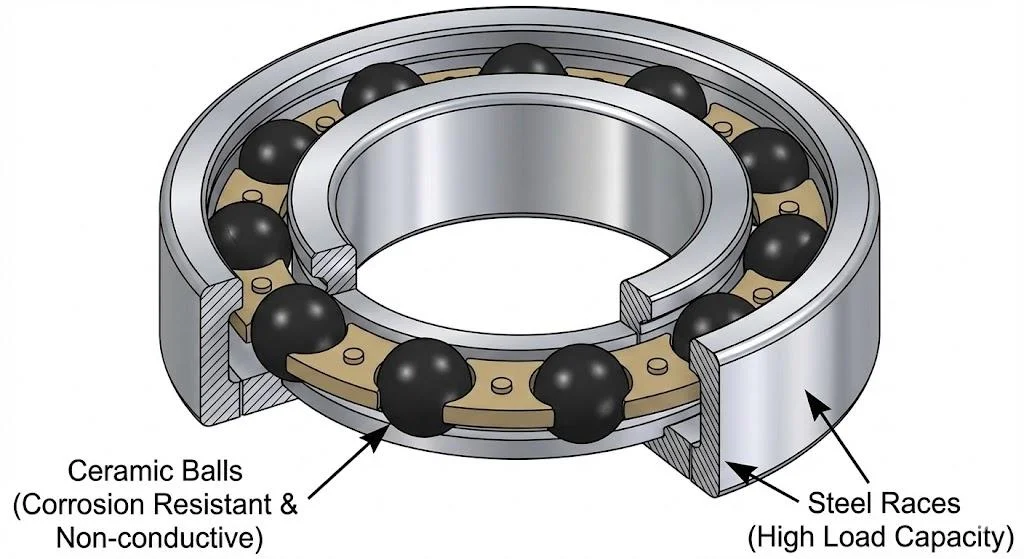
Frequently Asked Questions (FAQ)
Q1: What is the maximum impact load that glass balls can withstand without fracturing?
A: Borosilicate glass balls exhibit brittle fracture behavior with zero impact energy absorption through plastic deformation. Laboratory drop-test data indicates:
Safe impact threshold: < 2 J/cm2 (equivalent to dropping a 12.7mm ball from 15 cm height onto hardened steel surface)
Catastrophic failure zone: > 5 J/cm2 results in complete shattering
Practical guideline: Glass ball bearings should only be used in applications with shock loads < 2× static load rating and installation procedures must include elastomeric shock mounts (Shore A 60-70 durometer) to attenuate impact transmission. For applications with frequent shock loads (pneumatic cylinders, impact tools), hardened steel balls remain the only viable option.
Q2: How should glass balls be handled during installation to prevent micro-cracking?
A: Glass ball surface is highly sensitive to point-load damage. Follow these best practices:
Handling protocols:
Wear powder-free nitrile gloves: Skin oils create localized stress concentrations during subsequent heat exposure
Use plastic tweezers or vacuum pick tools: Metal tools can induce surface chips
Avoid ball-to-ball contact: Store in individual pockets (plastic trays with conical indentations)
Temperature acclimation: Allow 2-hour thermal soak to ambient temperature before installation (prevents thermal shock from cold storage)
Installation technique:
Press-fit tolerance: Maximum 5 μm interference (H7/h6 fit)
Preload application: Use torque wrench for threaded retainers (glass balls cannot withstand edge loading from over-tightening)
Alignment verification: Use dial indicator to confirm < 0.3° angular misalignment
Rejected practices:
Hammer-driving glass balls into races (causes subsurface Hertzian cone cracks)
Compressed air blow-off cleaning (can embed particles that act as stress concentrators)
Q3: Do glass ball bearings require special lubricants compared to steel ball bearings?
A: Yes, glass balls' lower surface energy (42 mN/m vs. 1,500 mN/m for steel) affects lubricant film formation. Optimal lubrication strategies:
For borosilicate glass balls:
Synthetic PAO oils: Polyalphaolefin base (viscosity ISO VG 32-68 at operating temperature)
Perfluoropolyether (PFPE) greases: Superior wetting on glass, wide temperature range (-60°C to +250°C)
Avoid: Mineral oils with sulfur/phosphorus EP additives (react with glass surface at elevated temperatures)
Dry lubrication options:
MoS? solid film: 0.5-1.0 μm coating thickness (suitable for vacuum environments)
PTFE composite cages: Self-lubricating, no liquid lubricant required (friction coefficient 0.08-0.12)
Lubrication frequency: Glass's low surface energy causes faster lubricant migration. Re-lubrication intervals are 30-40% shorter than steel ball bearings in equivalent applications (e.g., 500 hours vs. 1,200 hours for steel).
Q4: How do glass balls compare to ceramic balls (Si?N?, Al?O?) in terms of performance and cost?
A: Material selection depends on application priorities:
Glass balls advantages over ceramics:
Cost: 85-90% lower than silicon nitride balls ($0.60 vs. $3.50 for 12.7mm ball)
Non-magnetic property: Identical μr = 1.000 (both suitable for MRI equipment)
Machinability: Easier to drill holes or add threaded features for custom applications
Thermal shock resistance: Borosilicate glass (ΔT = 120°C) outperforms alumina ceramic (ΔT = 80°C)
Ceramic balls advantages over glass:
Load capacity: Si?N? compressive strength 3,000-3,500 MPa (4× higher than glass)
Hardness: HV 1,600-1,800 vs. HV 550-600 for glass (superior wear resistance)
High-speed capability: Ceramic balls rated for 50,000+ rpm (glass limited to 10,000 rpm)
Extreme temperatures: Si?N? operates continuously at 800°C (glass max 400°C)
Decision matrix:
Choose glass balls when: Budget < $1,000, loads < 50N/ball, non-magnetic + corrosion resistance required
Choose ceramic balls when: High loads (> 100N), high speeds (> 15,000 rpm), or extreme temperatures (> 400°C)
Q5: What happens if a glass ball fractures during operation? Will it contaminate the entire system?
A: Glass ball failure mode differs significantly from steel ball spalling:
Fracture characteristics:
Fragmentation pattern: Tempered glass shatters into 3-8mm blunt pieces (not sharp shards)
Particle count: Typical fracture generates 50-150 fragments from a 12.7mm ball
Debris composition: Chemically inert SiO? (non-toxic, non-reactive in most environments)
Contamination risk assessment:
Low-risk scenarios:
Open systems with filtration (chemical pumps, conveyors)
Non-critical applications where temporary shutdown is acceptable
Systems with debris traps or magnetic separators (glass is non-magnetic, easy to separate from steel components)
High-risk scenarios (glass balls NOT recommended):
Sealed gearboxes or transmissions (debris causes secondary damage)
High-pressure hydraulic systems (fragments block orifices)
Medical implants or critical aerospace components (zero-tolerance for failure)
Mitigation strategies:
Redundant bearing design: Dual bearing sets with independent load paths
Containment shields: Polymer guards capture fragments before entering process stream
Condition monitoring: Vibration sensors detect bearing degradation 100-200 hours before fracture
Scheduled replacement: Conservative service life (use 30% of calculated L?? life)
Comparison to steel ball failure: Steel balls exhibit gradual spalling (flaking) with advance warning through increased vibration and temperature. Glass ball fracture is sudden but debris is chemically benign and non-magnetic (easier to clean).
Q6: Can glass balls be used in cryogenic applications (liquid nitrogen, liquid helium)?
A: Yes, with specific material and design considerations:
Temperature capability:
Borosilicate glass: Maintains mechanical properties down to -196°C (liquid nitrogen boiling point)
Soda-lime glass: NOT suitable (thermal shock fracture below -50°C)
Cryogenic application challenges:
Thermal contraction mismatch: Glass contracts 0.5-0.6 mm/m at -196°C; steel races contract 2.0-2.3 mm/m
Solution: Design initial clearance of 15-25 μm to prevent interference fit at cryogenic temps
Lubricant failure: Conventional greases solidify below -40°C
Solution: PFPE oils (remain fluid to -80°C) or dry MoS? coatings
Embrittlement: Glass fracture toughness decreases 15-20% at cryogenic temperatures
Mitigation: Reduce load ratings by 25% safety factor
Successful applications:
Cryogenic pump bearings (LNG transfer systems)
Superconducting magnet positioning stages
Laboratory cryostats and vacuum chambers
Thermal cycling protocol: Cooling rate must not exceed 5°C/min to prevent thermal shock fracture during system startup/shutdown.
Q7: What quality inspection methods detect internal defects in glass balls before they cause field failures?
A: Multi-stage inspection protocol for high-reliability applications:
Stage 1: Visual screening (100% inspection)
10× magnification optical inspection
Reject criteria: Surface chips > 5 μm, scratches > 0.02 mm Ra
Stage 2: Polarized light stress analysis (sampling or 100%)
Cross-polarizers reveal birefringence patterns
Reject threshold: Residual stress > 50 MPa (indicates quenching defects)
Cost: $0.15-0.30 per ball for automated inspection
Stage 3: Ultrasonic C-scan (critical applications)
Detects subsurface voids, inclusions, delaminations > 20 μm
Frequency: 25-50 MHz immersion transducers
Throughput: 200-300 balls/hour (slower but essential for aerospace/medical)
Stage 4: Proof load testing (destructive sampling)
Apply 150% of rated load for 60 seconds
Statistical sampling: 0.4% AQL (Acceptable Quality Limit)
Validates batch strength consistency
Recommended inspection levels:
Standard industrial: Visual + polarized light (99.5% defect detection)
High-reliability (medical, aerospace): Full protocol including ultrasonic (99.97% detection)
Q8: What is the Minimum Order Quantity (MOQ) for custom glass balls?
A: Glass ball manufacturing economics differ significantly from steel ball production:
Typical MOQ structure:
Standard sizes (6mm-19mm borosilicate): 5,000-10,000 pieces minimum
Custom diameters or specifications: 10,000-25,000 pieces (tooling setup costs)
Lead time: 6-10 weeks for first production run
Cost drivers:
Glass melting batch size requirements (minimum 50-100 kg melt)
Precision grinding wheel dressing for specific dimensions
Quality inspection setup (polarized light fixtures, ultrasonic calibration)
Alternative for small quantities:Many applications that initially specify glass balls can be satisfied with 316L stainless steel balls or ceramic-steel hybrid bearings at much lower MOQ (as low as 100-500 pieces) and shorter lead times (2-4 weeks).
Our recommendation: Before committing to large glass ball orders, contact our engineering team for a free material compatibility assessment. In our experience, approximately 60% of initial "glass ball inquiries" can be better served with corrosion-resistant steel grades or hybrid solutions that offer:
Lower total cost (3-5× savings)
Immediate availability from stock
Higher load capacity and impact resistance
For conventional precision steel balls , Changzhou Eurasian offers flexible MOQ starting from 1,000 pieces with same-week delivery for common sizes.
Conclusion: Strategic Material Selection for Optimized Bearing Performance
Glass ball bearings represent a specialized solution for applications where non-magnetic properties, chemical inertness, and electrical insulation are non-negotiable requirements. However, their inherent brittleness and limited load capacity restrict usage to < 5% of global bearing applications.
When to specify glass balls:
? MRI equipment and electromagnetic-sensitive instruments
? Corrosive chemical processing (excluding HF environments)
? Ultra-high purity semiconductor/pharmaceutical manufacturing
? Electrical insulation requirements (> 10 kV/mm dielectric strength)
? FDA food-contact compliance with frequent steam sterilization
When steel balls or hybrid solutions remain superior:
? Radial loads > 100N per ball or rotational speeds > 15,000 rpm
? Applications with shock loads or impact forces
? Cost-sensitive industrial automation and machinery
? High-volume production requiring immediate availability (MOQ < 5,000 pcs)
? Environments where gradual wear monitoring prevents catastrophic failures
The Hybrid Bearing Advantage
Before committing to full glass ball assemblies, consider hybrid bearing configurations that combine the best properties of multiple materials:
Ceramic balls + steel races: High load capacity with corrosion resistance (30% cost savings vs. full ceramic)
Glass balls + polymer races (PEEK/PPS): Maximum chemical inertness for pharmaceutical applications
Coated steel balls + ceramic races: Cost-effective solution for moderate corrosion environments
For 95% of industrial bearing applications, Changzhou Eurasian Steel Ball Co., Ltd. provides IATF 16949:2016 certified precision steel balls with:
GCr15 chrome steel balls: HRC 60-65 hardness, G10-G28 precision grades, 1mm-100mm diameters
316L/440C stainless steel balls: Corrosion-resistant grades for chemical and marine environments
CQI-9 compliant heat treatment: Controlled quenching + tempering for consistent metallurgical properties
In-house quality laboratory: Roundness measurement (±0.01 μm), hardness testing (±0.5 HRC), spectral analysis
Flexible MOQ: Starting from 1,000 pieces with 2-4 week lead times for standard sizes
Need expert guidance? Contact our engineering team for a free material compatibility assessment and application analysis. We'll help you determine whether glass balls, steel balls, or a hybrid solution best meets your performance and budget requirements.
Common alternative solutions we recommend:
316L stainless steel balls with electropolishing (mirror finish Ra < 0.05 μm) for food/pharma applications
Silicon nitride ceramic balls for high-temperature, high-speed requirements exceeding glass capabilities
TiN-coated GCr15 balls for chemical resistance at 40% the cost of glass balls
Related technical resources:
Stainless Steel Ball Selection Guide: 316L vs 440C Performance Comparison
GCr15 Bearing Steel Heat Treatment Standards & CQI-9 Compliance
Hybrid Bearing Design: Optimizing Material Combinations for Corrosive Environments
Precision Grade Comparison: Understanding G10 vs G20 vs G28 Tolerances


