


News


How Steel Balls Are Manufactured?
Precision steel balls play an essential role in modern machinery, from automotive components and aerospace assemblies to medical devices and industrial equipment. Their performance depends on strict dimensional accuracy, consistent hardness, and flawless surface finish—qualities that result from a complex and carefully controlled manufacturing process. In this blog post, Changzhou Eurasian, as high quality custom industrial steel balls manufacturer, will share how high precision steel balls are manufactured.
Understanding High Precision Steel Balls and Their Manufacturing Foundations
The production of high precision steel balls begins long before the first piece of metal enters a machine. Manufacturers must select appropriate steel grades, verify material certificates, and ensure traceability. The accuracy of diameter, roundness, and surface finish depends on maintaining strict standards from raw material inspection through final packaging.
This section introduces the essential foundation: using high-quality wire stock and conducting thorough material checks before the forming stage begins.
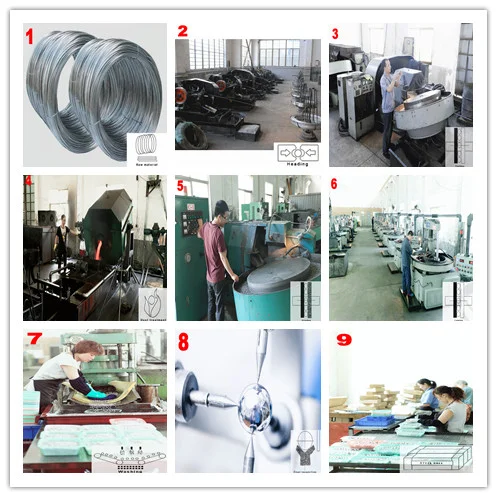
Raw Material Inspection for Precision Steel Ball Manufacturing
Manufacturing starts with steel wire, typically provided on coils. Before processing, technicians visually inspect the material to identify any surface flaws, corrosion, or defects. Dimensional verification ensures that the wire diameter is consistent and matches production requirements.
Material certificates are carefully reviewed to confirm chemical composition, mechanical properties, and heat-treatment history. Only wire that meets strict standards enters the next step. This initial screening is critical, as even small inconsistencies can lead to dimensional errors during shaping.
Cold Heading Forming the Initial Shape of High Precision Steel Balls
Cold heading is the first transformation step—converting wire into a roughly spherical slug. A heading machine cuts the wire into segments known as slugs, then compresses each piece between two hemispherical dies.
Key characteristics of cold heading include:
Room-temperature forging, which maintains material strength
High manufacturing speeds, often producing one large ball per second
Excess material usage to ensure the cavity fills completely
This process forms an initial sphere known as a “wire ball.” Although not perfectly round, the structure is strong and ready for further refinement.
Flashing Removing Excess Material from Semi-Finished Steel Balls
After cold heading, steel balls have a thin ridge of excess metal around the midline, known as the flash. The flashing process removes this unwanted material by rolling the balls between grooved cast-iron plates.
Repeated passes gradually shave down the flash without damaging the spherical geometry. This stage is critical for preparing the balls for accurate grinding and ensuring uniformity across the batch.
Heat Treatment Creating Durable and High Hardness Steel Balls
To meet performance requirements, the balls undergo controlled heat treatment. A rotary furnace ensures each piece is exposed uniformly to correct heating conditions.
The quench and temper process involves:
Heating to the required temperature
Oil quenching, rapidly cooling the balls to form martensite, a phase with high hardness and excellent wear resistance
Tempering, relieving internal stresses and stabilizing mechanical properties
The final hardness range is essential for producing high precision steel balls that can withstand continuous friction, pressure, and rotational forces in applications like bearings or mechanical components.
Grinding Bringing Precision Steel Balls to Near-Final Dimensions
Grinding occurs both before and after heat treatment. Pre-hard grinding removes imperfections created during flashing and prepares the surface for heat treatment. After hardening, finish grinding (hard grinding) is conducted to refine dimensional accuracy.
In this stage:
Diameter tolerance is precisely controlled
Roundness (sphericity) becomes significantly improved
Surface roughness is further reduced
Grinding is conducted in batches, and lot size depends on the capacities of grinding and lapping systems. This stage brings each steel ball much closer to its final grade requirements.
Lapping Achieving Ultra-Smooth Surfaces for High Precision Steel Balls
Lapping is a slower but highly critical finishing process. Using phenolic plates and extremely fine abrasive slurries such as diamond dust, this stage polishes the ball’s surface to near-perfect smoothness.
Lapping is essential for:
High precision ball grades
Super precision or micro-precision specifications
Applications requiring minimal friction and long service life
The reduced material removal rate ensures exceptional accuracy without altering dimensional stability.
Cleaning Ensuring the Purity of High Precision Steel Balls
After grinding and lapping, balls undergo cleaning to remove oils, abrasives, and residues. Depending on customer needs, cleaning procedures vary in complexity. Industries such as medical equipment, electronics, and food processing often require advanced multi-stage cleaning to ensure surfaces are free of contaminants.
This stage not only enhances appearance but also ensures compatibility with delicate or sensitive applications.
Visual Inspection Verifying Surface Integrity of Precision Balls
Each batch goes through visual inspection to ensure no defects remain. Quality controllers examine the balls for:
Rust
Scratches
Contamination
Surface inconsistencies
This inspection is especially important for industries that require cosmetically flawless components or where surface defects could compromise function.
Roller Gauging Sorting High Precision Steel Balls by Dimensional Accuracy
Roller gauging is a 100% sorting method used to detect undersize or oversize balls. By rolling each piece between precision-calibrated rollers, the machine sorts out any balls that fall outside the acceptable dimensional range.
This ensures that only perfectly sized precision balls proceed to final quality checks and packaging.
Quality Control Ensuring Final Tolerance and Surface Requirements
Comprehensive testing ensures every specification is met. QC teams validate:
Diameter tolerance
Roundness (sphericity)
Surface roughness
Hardness consistency
Visual quality
Specialized measurement instruments, including roundness testers and surface profilometers, confirm the accuracy of each batch. Customer-specific requirements are also evaluated at this stage.
Packaging Protecting High Precision Steel Balls During Transport
Once fully approved, the balls are dried and packaged in plastic bags with vapor corrosion inhibitor (VCI) paper. For corrosion-sensitive materials, VCI bags or dry-to-touch oils may be added.
Packaging is customized to meet customer specifications regarding label format, carton weight, and protective measures. Proper packaging ensures that high precision steel balls reach customers in excellent condition.
Why Changzhou Eurasian Is a Reliable Partner for High Precision Steel Balls
Changzhou Eurasian adheres to rigorous international production standards and focuses on delivering stable quality across large-volume orders. With advanced equipment, strong technical reserves, and strict quality control, the company provides steel ball solutions that meet global industrial requirements.
Whether for bearings, automotive systems, linear motion equipment, or high-precision instruments, Changzhou Eurasian offers reliable supply and professional support.
Conclusion
The manufacturing journey—from raw material inspection to final packaging—requires accuracy, consistency, and meticulous craftsmanship. High precision steel balls depend on each process step to achieve flawless performance in their end applications. If you need stable and professional supply of high precision steel balls, Changzhou Eurasian welcomes your inquiry. Let’s work together to support the success of your mechanical systems and industrial projects!


