


News


Matching Alloy Balls to Wear, Heat, and Corrosion Challenges
Selecting the right alloy balls is not simply a matter of choosing the hardest available material. Industrial ball components operate under different combinations of load, friction, impact, temperature, chemical exposure, and dimensional requirements. A material that performs exceptionally well against abrasive wear may not be the best option when repeated impact or severe corrosion is involved. For this reason, material selection should begin with the actual operating conditions rather than hardness alone.
For manufacturers and industrial buyers, the right alloy ball can influence equipment reliability, component life, maintenance intervals, and operating costs. Changzhou Eurasian provides alloy steel ball solutions covering different performance requirements, including wear resistance, toughness, corrosion resistance, high-temperature stability, and precision. With available diameters from 0.5 mm to 50 mm and precision grades from G10 to G1000, the selection can be adapted to both precision components and demanding industrial applications.
Why Alloy Balls Need Application-Based Material Selection
Industrial applications rarely expose a ball to only one type of stress. A bearing ball may experience continuous rolling contact and fatigue, while a valve ball may face pressure, corrosion, temperature fluctuations, and repeated movement. Grinding media can encounter severe abrasion and impact at the same time. These conditions make material compatibility more important than selecting a ball based on one specification.
Hardness is an important indicator because it generally contributes to resistance against surface deformation and abrasive wear. However, excessive hardness without sufficient toughness can increase the risk of cracking under impact. Conversely, a material with excellent toughness but inadequate surface hardness may wear too quickly in abrasive conditions. The most effective alloy steel balls therefore balance hardness, toughness, chemical stability, and thermal performance according to the intended application.
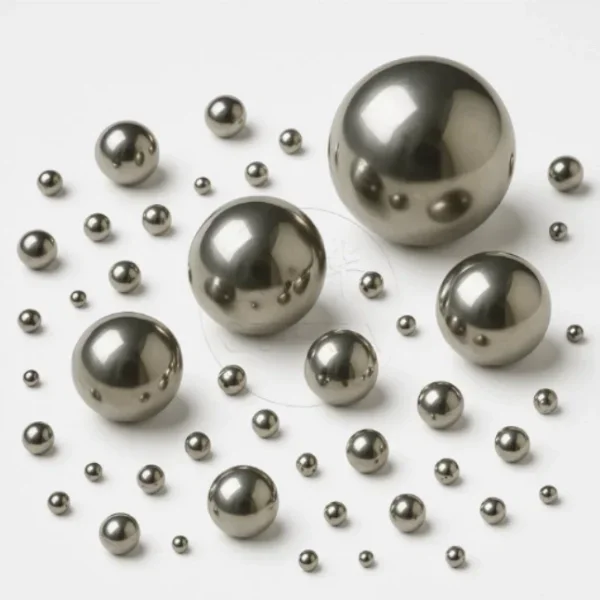
Alloy Balls for Severe Wear and Abrasive Conditions
When continuous abrasion is the dominant concern, a high-hardness material can provide a significant service-life advantage. Tungsten carbide balls are particularly suited to applications where extreme wear resistance and compressive strength are required. Their very high hardness allows them to maintain dimensional stability under severe contact and abrasive conditions, making them suitable for precision bearings, grinding applications, ball mills, oil and gas equipment, and high-pressure components.
For applications where wear resistance must be balanced with mechanical toughness, carburized alloy steel can provide a more comprehensive performance profile. Its hardened outer surface helps resist wear, while the tougher internal structure supports impact resistance. This balance makes alloy balls suitable for heavy mechanical components where both surface durability and structural reliability are important.
Matching Ball Hardness With Operating Stress
Higher hardness does not automatically mean better performance. The correct hardness depends on how the ball is loaded and how the surrounding material interacts with its surface. Under repeated impact, a material with insufficient toughness may suffer premature damage even if its hardness is high. In rolling applications, excessive surface stress can also accelerate fatigue if the material selection does not match the contact conditions.
For this reason, precision alloy steel balls should be selected according to the complete operating environment. Load intensity, contact pressure, motion type, lubrication, contamination, and expected service life should all be considered before deciding on a material or precision grade.
Alloy Steel Balls for High-Impact Applications
Some industrial equipment exposes balls to repeated shock rather than purely continuous abrasion. In these environments, toughness becomes a critical selection factor. Tool steel balls are designed to provide a practical balance between hardness and impact resistance, helping them withstand repeated mechanical loading without sacrificing surface durability.
This makes them suitable for pneumatic tools, power tools, fasteners, and valve-related components where impact and fatigue can occur simultaneously. Impact-resistant alloy balls should maintain their structural integrity during repeated loading while offering sufficient surface hardness to control wear. Selecting a material purely according to its maximum hardness may therefore produce a less effective result than choosing a balanced material.
Corrosion Resistance Matters in Harsh Media
Mechanical performance alone is not enough when balls operate in seawater, acids, alkalis, or chemically active fluids. Corrosion can gradually alter the surface, affect dimensional accuracy, and shorten service life. In these environments, nickel-copper alloy balls such as Monel materials provide a strong alternative to conventional alloy steels.
Their corrosion resistance makes them suitable for marine engineering, chemical pumps and valves, petroleum equipment, and pharmaceutical machinery. Corrosion-resistant alloy balls are particularly valuable where exposure to seawater or aggressive chemical media is combined with mechanical movement. The broad operating temperature capability of nickel-copper alloys also provides flexibility where environmental conditions fluctuate significantly.
Choosing Materials for Chemical Exposure
The type and concentration of the corrosive medium should be evaluated before selecting a ball material. Temperature can also change corrosion behavior, meaning that the same material may perform differently under elevated or reduced temperatures. For demanding applications, buyers should consider the chemical environment together with mechanical loading rather than treating corrosion resistance as an isolated property.
This approach helps prevent premature surface degradation and supports more consistent component performance. It is especially important for alloy balls for chemical equipment, where dimensional stability and material compatibility can directly affect valve sealing, fluid handling, and equipment maintenance.
High-Temperature Applications Require More Than Hardness
Elevated temperature can significantly influence the mechanical properties of metallic materials. A ball that performs effectively at room temperature may lose hardness, strength, or wear resistance when exposed to sustained heat. High-temperature applications therefore require materials capable of retaining useful mechanical properties under thermal stress.
Cobalt-based alloy balls such as Stellite materials are engineered for demanding high-temperature environments. Their resistance to oxidation, corrosion, and wear makes them suitable for high-temperature valves, turbomachinery, aerospace components, and heat treatment equipment. High-temperature alloy balls are especially useful when conventional materials cannot maintain sufficient surface performance as operating temperatures increase.
The temperature range should always be evaluated together with load and wear conditions. A high-temperature material may offer excellent thermal stability but still require careful consideration of dimensional tolerance, contact pressure, and surrounding components. Material selection is most effective when these factors are assessed together.
Comparing Alloy Ball Materials by Performance Need
Rather than comparing materials only by hardness, industrial buyers can evaluate them according to the dominant operating challenge.
| Operating Challenge | Preferred Material Direction | Main Performance Focus |
|---|---|---|
| Severe abrasive wear | Tungsten carbide | Extreme hardness and wear resistance |
| Repeated impact | Tool steel | Toughness and shock resistance |
| Seawater and chemical exposure | Nickel-copper alloy | Corrosion resistance |
| Heavy mechanical loading | Carburized alloy steel | Strength, toughness, and fatigue resistance |
| Elevated temperature | Cobalt-based alloy | Heat, oxidation, and wear resistance |
This performance-based approach makes it easier to identify industrial alloy balls for a specific application without relying on a single material property. It also helps buyers avoid unnecessary over-specification, which can increase material and manufacturing costs without delivering meaningful performance benefits.
Precision Requirements and Surface Quality
Material selection is only one part of alloy ball performance. Dimensional accuracy, roundness, surface condition, and precision grade can become critical when balls are used in bearings or other precision assemblies. A small deviation can influence contact behavior, friction, noise, vibration, and component life.
Changzhou Eurasian supplies alloy balls across precision grades from G10 to G1000, allowing customers to match accuracy requirements with the demands of their applications. Precision alloy balls for bearings require tighter control than balls intended for less critical industrial functions. The appropriate grade should therefore be determined by the mechanical design and required operating accuracy rather than automatically selecting the highest available precision.
Manufacturing Quality Influences Long-Term Performance
Consistent raw material composition is essential for achieving predictable mechanical properties. Variations in alloy chemistry can affect hardness, toughness, corrosion resistance, and heat-treatment response. For this reason, quality control should begin with raw material selection and continue through forming, heat treatment, finishing, dimensional inspection, and final testing.
A dependable manufacturer should also be able to provide material certificates and test reports when required. Changzhou Eurasian applies quality controls covering dimensional accuracy, surface finish, hardness, and material composition, with products manufactured according to applicable international requirements such as ISO 3290, AFBMA, and DIN standards.
Custom Alloy Balls for Specialized Requirements
Standard materials and dimensions may not always satisfy demanding industrial applications. Different equipment designs can require special diameters, material combinations, precision grades, or performance characteristics. Custom manufacturing allows the ball specification to be matched more closely with actual operating conditions.
Changzhou Eurasian supports customized alloy steel ball manufacturing for special sizes, materials, and precision requirements. Both small and larger production quantities can be accommodated, making customization practical for engineering development as well as established industrial procurement. Providing information about load, temperature, medium, wear mechanism, and dimensional requirements can help determine a more appropriate material solution.
How to Select the Right Material
A practical selection process should begin by identifying the primary failure mechanism. If abrasion is the main concern, hardness and wear resistance should receive greater attention. If repeated shock dominates, toughness becomes more important. For chemical exposure, corrosion resistance should be prioritized, while elevated-temperature applications require stable mechanical properties under heat.
The next step is to consider operating load, motion, temperature, environmental conditions, required precision, and expected service life. This creates a complete performance profile rather than relying on one specification. Choosing the right alloy balls in this way can improve durability while avoiding unnecessary material costs or unsuitable performance characteristics.
FAQ
Are harder alloy balls always better?
No. Hardness improves resistance to deformation and wear, but excessive hardness can reduce toughness in some materials. Applications involving repeated impact may require a better balance between hardness and toughness rather than the highest possible hardness.
Which material is suitable for severe wear?
Tungsten carbide is an appropriate choice when extreme hardness, compressive strength, and wear resistance are the primary requirements. It is commonly considered for severe abrasive conditions where long service life is critical.
Which alloy balls resist seawater corrosion?
Nickel-copper alloy balls are well suited to seawater and many corrosive environments. They can be considered for marine engineering, chemical equipment, pumps, and valves where corrosion resistance is a major requirement.
What should be considered for high-temperature applications?
Temperature, mechanical load, oxidation, corrosion, and wear should all be evaluated together. Cobalt-based alloy balls are suitable for demanding high-temperature applications because they can retain useful wear and mechanical performance at elevated temperatures.
Can alloy balls be customized?
Yes. Changzhou Eurasian can provide customized sizes, materials, and precision grades according to application requirements. Customers can discuss operating conditions and technical specifications with the manufacturer to determine a suitable solution.
How precise can alloy balls be?
Alloy balls are available in precision grades ranging from G10 to G1000. The appropriate grade depends on the application, with tighter precision generally required for demanding bearing and precision-motion applications.


