


News


Roll-On Bottle Balls: A Material Selection Guide for Cosmetic Packaging
For roll-on bottle and valve manufacturers, the correct question is therefore not “Which material is best?” It is “Which material, surface condition, and dimensional specification work with this formulation and package geometry?”
The five material families most commonly evaluated are:
PP (polypropylene), including hollow PP balls
POM (polyoxymethylene/acetal), normally solid balls
Soda-lime or borosilicate glass
304 or 316L stainless steel
Alumina ceramic
This guide compares their practical advantages, limitations, and best-fit applications in perfumes, antiperspirants, eye serums, essential oils, and high-value skincare.
Quick Material Selection Table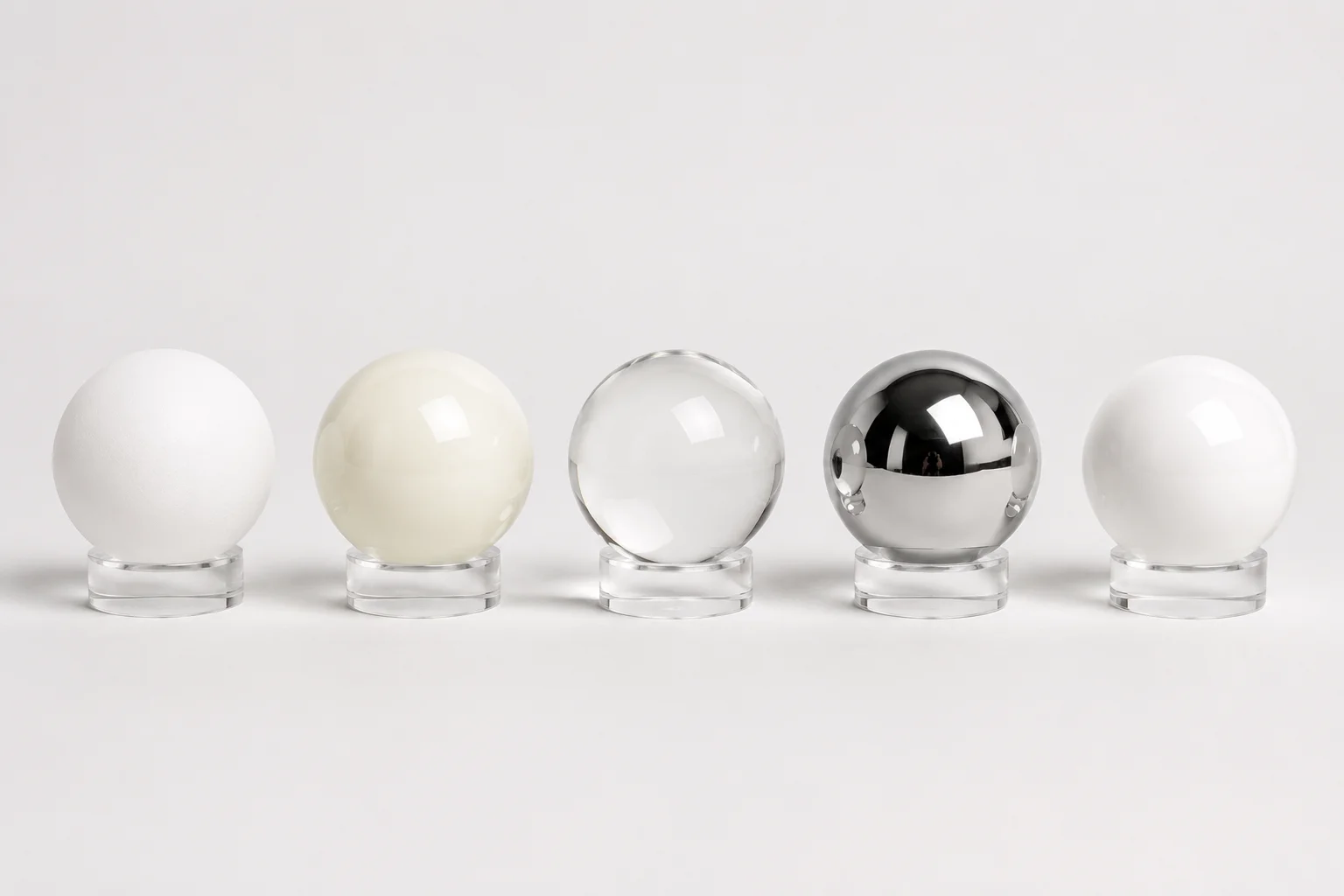
| Ball material | Typical density | Main advantage | Primary risk | Best-fit products | Relative cost |
|---|---|---|---|---|---|
| Hollow PP | Below solid PP; design-dependent | Lowest cost and gentle rolling feel | Swelling, odor absorption, or stress effects with incompatible fragrance oils/solvents | Mass-market water-based antiperspirants and body deodorants | $ |
| Solid PP | About 0.90 g/cm3 | Lightweight and broadly resistant to many aqueous formulations | Low weight may not dispense viscous formulas effectively | Basic water- or alcohol-based roll-ons | $ |
| POM/acetal | About 1.41 g/cm3 | Low friction, good wear resistance, and dimensional stability | Compatibility depends on resin grade, pH, temperature, oils, and additives | Neutral lotions and medium-viscosity formulas | $$ |
| Soda-lime glass | About 2.4–2.5 g/cm3 | Smooth appearance and good general chemical resistance | Breakage and potentially higher ionic extraction than borosilicate glass | Fragrance and oil products after compatibility testing | $$ |
| Borosilicate glass | About 2.2–2.3 g/cm3 | High hydrolytic resistance and low formulation interaction | Brittle and sometimes too light for thick creams | Perfume, essential oils, and sensitive natural formulations | $$$ |
| 304 stainless steel | About 7.9 g/cm3 | High mass, premium cooling sensation, and reliable flow in viscous products | Surface contamination or unsuitable chemistry can cause staining or ion release | Eye serum, eye cream, and premium skincare | $$$ |
| 316L stainless steel | About 8.0 g/cm3 | Better resistance than 304 in many chloride-containing environments | Higher cost; still requires formula-specific testing | Saline, mildly acidic, perfume, oil, and premium formulas | $$$–$$$$ |
| Alumina ceramic | About 3.6–3.95 g/cm3, purity-dependent | High hardness, wear resistance, and chemical stability | Highest cost, brittle impact behavior, and longer lead time | High-value active serums and sensitive-skin or prestige lines | $$$$ |
Important: Density and general resistance data are screening tools, not final approval criteria. Commercial grades, pigments, fillers, molding stresses, surface treatments, and the complete formulation can change performance.
Why Ball Material Changes Package Performance
The same bottle and valve housing can behave differently when the ball material changes. A steel ball can weigh more than eight times as much as a PP ball of the same diameter. That difference affects breakaway force, formula transfer, skin pressure, and how readily a viscous product wets the ball.
The material also influences:
Chemical compatibility: swelling, cracking, corrosion, discoloration, odor change, or extractables
Dispensing performance: start-up torque, rolling continuity, film thickness, and output per stroke
Package integrity: leakage, evaporation, and sealing behavior at the ball-seat interface
Consumer experience: cooling sensation, drag, sound, perceived quality, and skin comfort
Production efficiency: dimensional consistency, automatic assembly, reject rate, and incoming inspection burden
For this reason, a ball should be qualified as part of the complete formula–ball–housing system, not as an isolated component.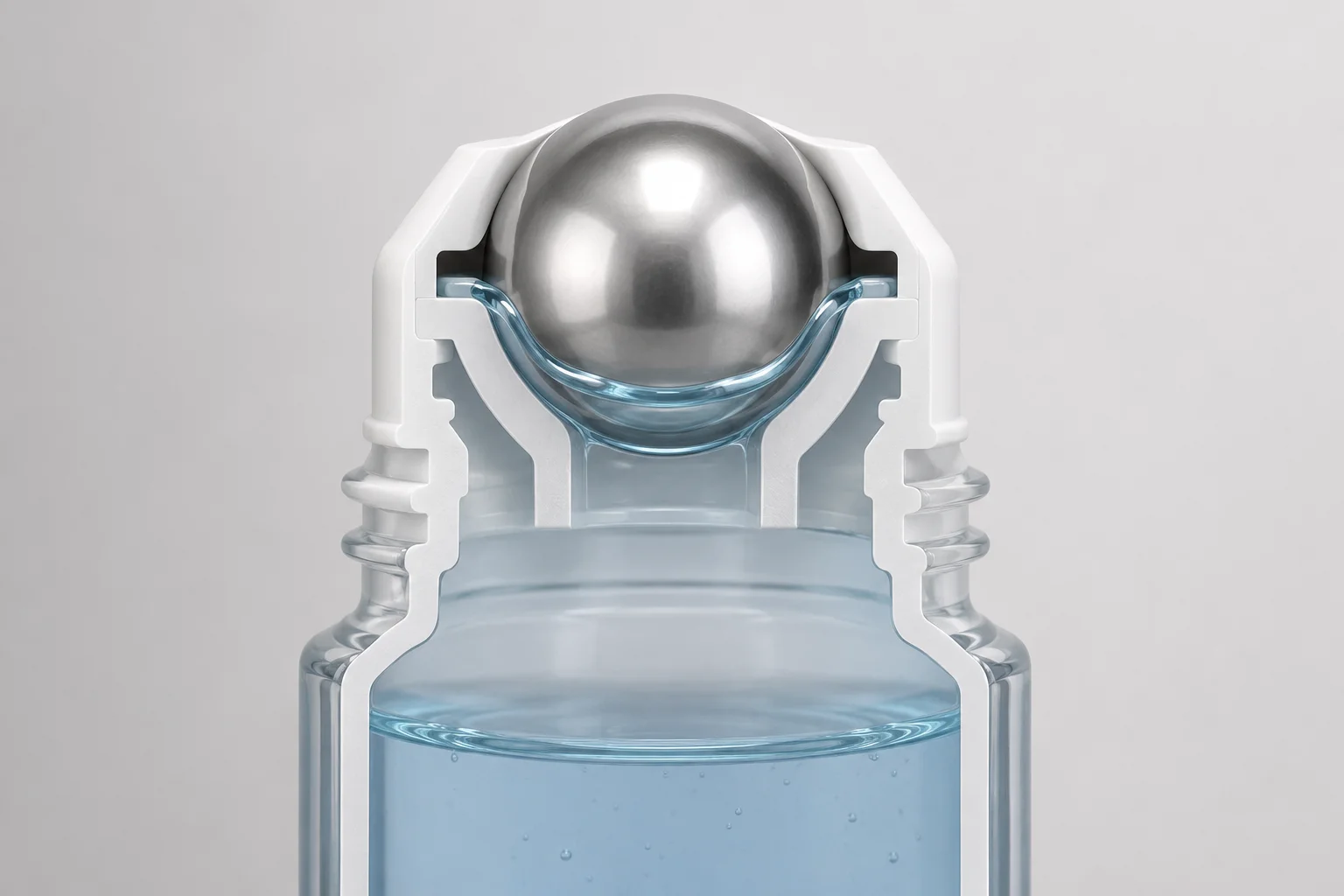
1. PP Roll-On Bottle Balls
PP is the usual starting point for high-volume, cost-sensitive roll-on packages. Solid PP has a typical density near 0.90 g/cm3, while a hollow construction reduces mass further.
Why Manufacturers Choose PP
Lowest unit cost among the five material groups
Suitable for high-volume injection molding
Lightweight, with a soft and non-cold skin feel
Generally resistant to water, many dilute acids and bases, and common alcohol-based systems
Hollow-ball designs can reduce weight and material consumption
LyondellBasell’s technical guidance notes that acids, bases, alcohols, detergents, lower ketones, aldehydes, and water-soluble salts are generally not considered antagonistic to PP. It also warns that actual performance depends on temperature, load, chemical combinations, and molded-in stress.
Limitations of PP
Low density may provide insufficient rolling force for high-viscosity serums or creams
Some fragrance oils, aromatic hydrocarbons, essential-oil constituents, and solvents may cause swelling, softening, stress cracking, or odor absorption
Scratches and molding defects can increase drag or create inconsistent output
The visual and tactile impression may not suit prestige skincare packaging
Best Applications
Mass-market antiperspirant roll-ons
Water-based deodorants
Basic body fragrance products with confirmed compatibility
PP should not be rejected solely because a formula contains alcohol or acid. Conversely, it should not be approved solely because the base formula is water. The exact resin grade and the complete fragrance package must be tested.
For high-volume projects, review our cosmetic packaging balls together with the housing drawing and filling specification.
2. POM Roll-On Bottle Balls
POM, also called acetal or engineering plastic, is selected when a packaging manufacturer wants a smoother and more wear-resistant plastic ball than PP. Typical unfilled POM density is approximately 1.41 g/cm3.
Why Manufacturers Choose POM
Low coefficient of friction and good self-lubricating behavior
Higher stiffness and wear resistance than PP
Low moisture absorption and good dimensional stability
Smooth breakaway and rolling performance
Suitable for solid precision balls with consistent geometry
Celanese describes commercial POM copolymers as having good sliding properties, low moisture absorption, and resistance to fuels, solvents, and strong alkalis. However, POM is not one universal formulation. Copolymer and homopolymer grades, stabilizers, pigments, processing history, temperature, and exposure time all affect compatibility.
Limitations of POM
Strong acids, oxidizing media, elevated temperature, or an unsuitable combination of fragrance ingredients may accelerate degradation
Some essential oils and solvent blends can create stress or surface changes in specific grades
It costs more than PP
High-temperature sterilization is generally unsuitable unless the selected grade and process are specifically validated
Best Applications
Neutral or mildly formulated lotions
Medium-viscosity skincare products
Packages requiring low friction without the weight or cooling feel of metal
POM should not be described categorically as “safe for perfume” or “unsafe for all acids.” A defensible specification requires supplier chemical-resistance data plus finished-formula immersion testing.
3. Glass Roll-On Bottle Balls
Glass is popular in essential-oil and natural-fragrance packaging because it offers a clean appearance and generally low interaction with many formulas. The two common options are soda-lime glass and borosilicate glass.
Soda-Lime Glass
Soda-lime glass is economical and provides a smooth, transparent surface. It is suitable for many standard fragrances and oils, but its hydrolytic resistance is normally lower than that of high-quality borosilicate glass.
Borosilicate Glass
Borosilicate glass is preferred where lower glass–formula interaction is important. SCHOTT Pharma describes Type I borosilicate glass as having high chemical and hydrolytic resistance and uses controlled-hydrolytic-resistance glass for sensitive formulations.
Advantages of Glass
Good resistance to many fragrance oils, alcohol systems, and plant extracts
Low odor absorption compared with many plastics
Smooth surface and premium transparent appearance
No metallic cooling effect or work-induced magnetism
Limitations of Glass
Brittle; impact or drop events can produce chips or fracture
Lower density than stainless steel may reduce output with thick creams
Tight dimensional sorting can increase cost
Glass should not be marketed as having “zero leachables”; glass composition, surface condition, hydrolytic resistance, pH, and exposure time still matter
Best Applications
Perfume and fragrance-oil roll-ons
Essential oils
Natural and organic skincare oils
Low- to medium-viscosity products where chemical stability is more important than ball mass
For portable products with a high drop risk, the finished package should undergo impact testing with the actual glass ball installed.
4. 304 and 316L Stainless Steel Roll-On Bottle Balls
Stainless steel is the leading choice when a brand wants a cooling touch, premium appearance, high wear resistance, and sufficient ball mass to transfer viscous product. It is widely used in eye serums, eye creams, facial massage applicators, and premium treatment products.
Why Stainless Steel Performs Well
High density—approximately 7.9 g/cm3 for 304 and 8.0 g/cm3 for 316L
Strong gravitational assistance for viscous formulas
Fast heat transfer creates a noticeable cooling sensation on skin
Mirror polishing supports a smooth, premium tactile experience
High impact resistance and long wear life
Excellent compatibility with automated sorting and dimensional inspection
Explore our stainless steel balls for cosmetic roll-on and dispensing applications.
304 vs. 316L Stainless Steel
304 stainless steel is often sufficient for water-based, alcohol-based, and mildly formulated cosmetic products after successful compatibility testing.
316L stainless steel contains molybdenum, which generally improves resistance to pitting and crevice corrosion in chloride-containing environments. The “L” indicates low carbon; its primary metallurgical benefit is reduced sensitization risk during welding or high-temperature exposure. For a cold-formed cosmetic ball, the molybdenum-containing 316 chemistry—not the “L” suffix alone—is the main reason for improved pitting resistance over 304.
Choose 316L stainless steel balls when the formulation contains meaningful chloride, salt, organic acids, botanical extracts, or other potentially aggressive ingredients, but still validate the final system.
Common Stainless Steel Failure Modes
Free-iron contamination from tooling, grinding, polishing, or handling
Residual abrasive, polishing compound, oil, or cleaning agent
Incorrect alloy substitution, including lower-cost 200-series stainless steel
Localized attack under a tight crevice or deposit
Work-induced magnetism from cold forming
Metal-ion release that contributes to formula discoloration, haze, or odor change
Liquid yellowing is not automatically proof that “304 reacts with perfume.” The failure can result from alloy mismatch, inadequate cleaning, free iron, an unsuitable passivation process, formula oxidation, light exposure, or interaction with another package component. A root-cause study should separate these variables.
Passivation Requirements
Passivation is intended to remove free iron and support a clean passive surface. ASTM A967/A967M-25 covers nitric, citric, and electrochemical passivation treatments and includes alternative verification tests. SAE AMS2700F likewise addresses removal of free iron and less-noble contaminants from corrosion-resistant steel surfaces.
However, neither standard declares a ball universally compatible with perfume, essential oil, or acidic serum. ASTM A967 itself states that it does not recommend the suitability of a grade, treatment, or acceptance criterion for a particular application.
A robust purchase specification should therefore combine:
Verified alloy chemistry by optical emission or X-ray fluorescence spectroscopy
Defined polishing and cleaning process
Contractually specified passivation method and acceptance test
Surface inspection for pits, scratches, residue, and staining
Finished-formula compatibility testing
A Hardness Warning for Buyers
304 and 316L are austenitic stainless steels. They can work-harden during forming, but they are not through-hardened to HRC 60–65 by conventional quench-and-temper treatment. If a supplier quotes HRC 60–65 for a supposedly 304 or 316L ball, verify the alloy immediately; that hardness range is more typical of hardened bearing or martensitic stainless grades.
For cosmetic stainless steel balls, alloy identity, roundness, polish, cleanliness, and passivation are usually more important than specifying a bearing-steel hardness.
5. Alumina Ceramic Roll-On Bottle Balls
Alumina ceramic is a premium option for high-value formulations that require strong wear resistance, non-magnetic behavior, and low material interaction. Commercial alumina may range from roughly 80% to more than 99% purity; properties vary accordingly.
Advantages of Alumina
Very high hardness and wear resistance
Excellent resistance to many chemicals
Non-magnetic and electrically insulating
Smooth polished surface with no metallic cold-work residue
Suitable for sensitive, high-value formulations after validation
CoorsTek notes that higher-purity alumina offers enhanced wear performance and that aluminum oxide ceramics resist a broad range of chemicals.
Limitations of Alumina
Highest material and processing cost in this comparison
Brittle impact behavior compared with stainless steel
Fewer suppliers and potentially longer lead times
Density is lower than stainless steel, so dispensing behavior will differ
“Zero extraction” should not be used as an absolute claim without analytical evidence
Best Applications
Prestige active serums
Sensitive-skin product lines
High-value oils or concentrates
Products where non-magnetic construction is a documented design requirement
Selection Logic by Cosmetic Product
Perfume and Fragrance-Oil Roll-Ons
Start with high-borosilicate glass when low odor absorption and low formulation interaction are priorities. Consider passivated 316L stainless steel when premium cooling, impact resistance, or higher ball mass is required.
Evaluate:
Ethanol concentration
Fragrance-oil percentage
Terpenes and aromatic constituents
Organic acids and water content
Color and odor stability
Metal-ion and extractables risk
Avoid approving PP or POM based only on a short room-temperature soak. Essential-oil blends can vary greatly, and molded-in stress may not become visible immediately.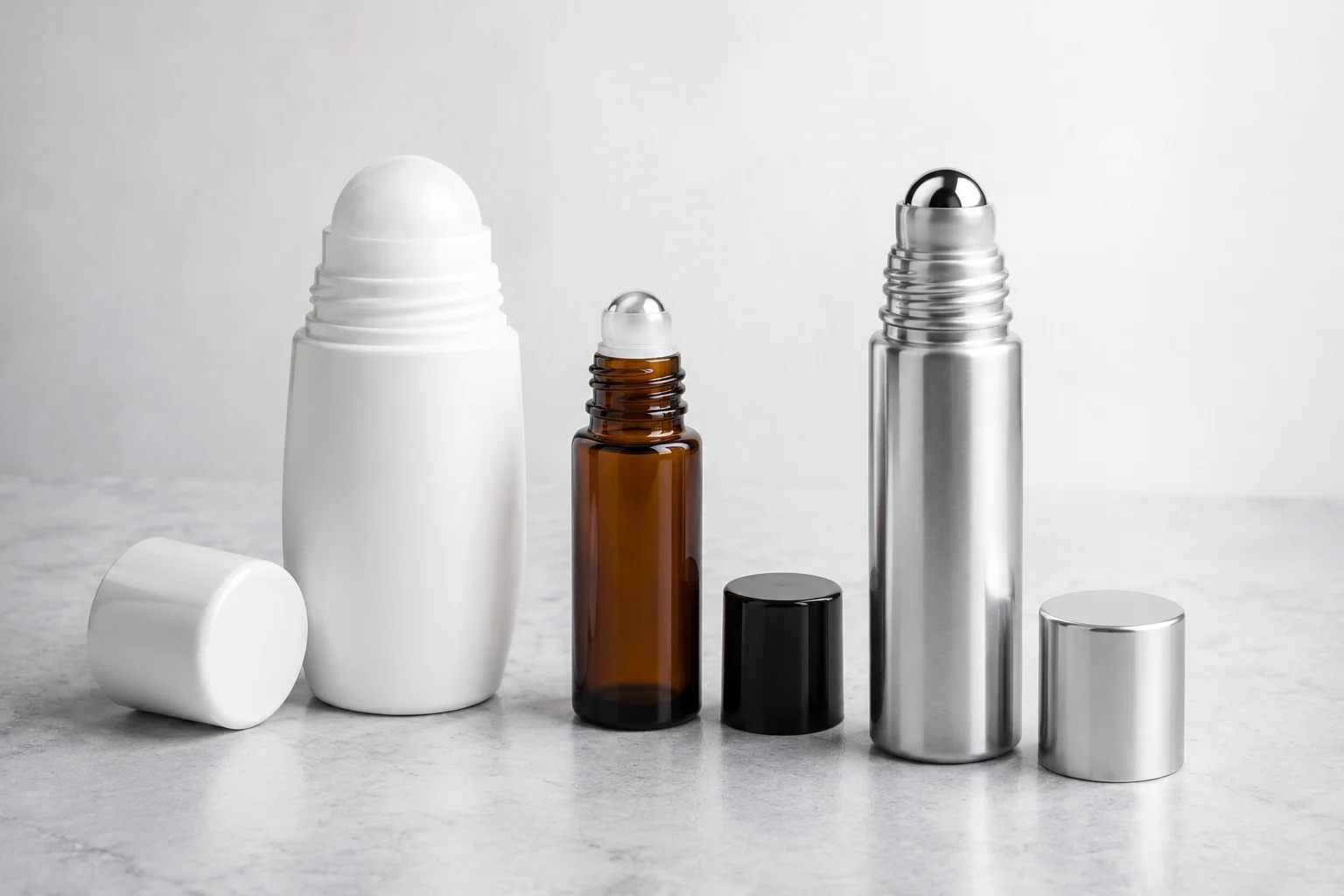
Mass-Market Antiperspirant and Deodorant
Hollow PP is normally the cost leader for high-volume water-based packages. Its light, gentle rolling feel is familiar to consumers.
The manufacturer should still confirm:
Salt and active concentration
Surfactant and fragrance compatibility
Ball-seat sealing under all storage orientations
Output after repeated use and formula drying at the seat
Eye Serum, Eye Cream, and De-Puffing Applicators
304 or 316L stainless steel is generally the preferred starting point because ball mass helps transfer viscous product and metal creates an immediate cooling sensation.
Use 316L when the formula has higher chloride, salt, acidity, or aggressive botanical content. Specify surface cleanliness and passivation, then confirm that cooling feel does not create condensation or consumer discomfort under the intended conditions.
Medical-Aesthetic and High-Activity Serums
High-purity alumina or carefully controlled 316L may be evaluated for premium formulas. The selection must be supported by extractables, metal-ion, stability, and package-function data rather than the perceived prestige of the material.
Dimensional Quality: Do Not Specify Material Alone
ISO 3290-1:2014 defines requirements for finished steel balls used in rolling bearings and was confirmed as current in 2025. DIN 5401 is also commonly referenced for balls used in rolling bearings and general industry.
These standards provide useful terminology for diameter, grade, roundness, and lot variation. However, a cosmetic roll-on is not a rolling bearing. A bearing grade such as G10 or G25 may add unnecessary cost without improving dispensing performance.
For roll-on packaging, specify the functional characteristics directly:
Nominal ball diameter
Individual diameter tolerance
Lot diameter variation
Maximum out-of-roundness
Surface roughness or an approved surface comparator
Visual defect limits for scratches, pits, chips, seams, and stains
Cleanliness and residue limits
Residual magnetism limit, when relevant to automated assembly
Sampling plan and lot traceability
A diameter tolerance such as ±0.02 mm and a polished-steel roughness target such as Ra ≤0.05–0.10 μm may be useful engineering starting points, but they are not universal acceptance limits. The correct values depend on ball diameter, housing shrinkage, seat geometry, formula rheology, and leakage target.
Use our precision steel ball manufacturing capabilities to develop a drawing-based specification instead of purchasing only by nominal diameter.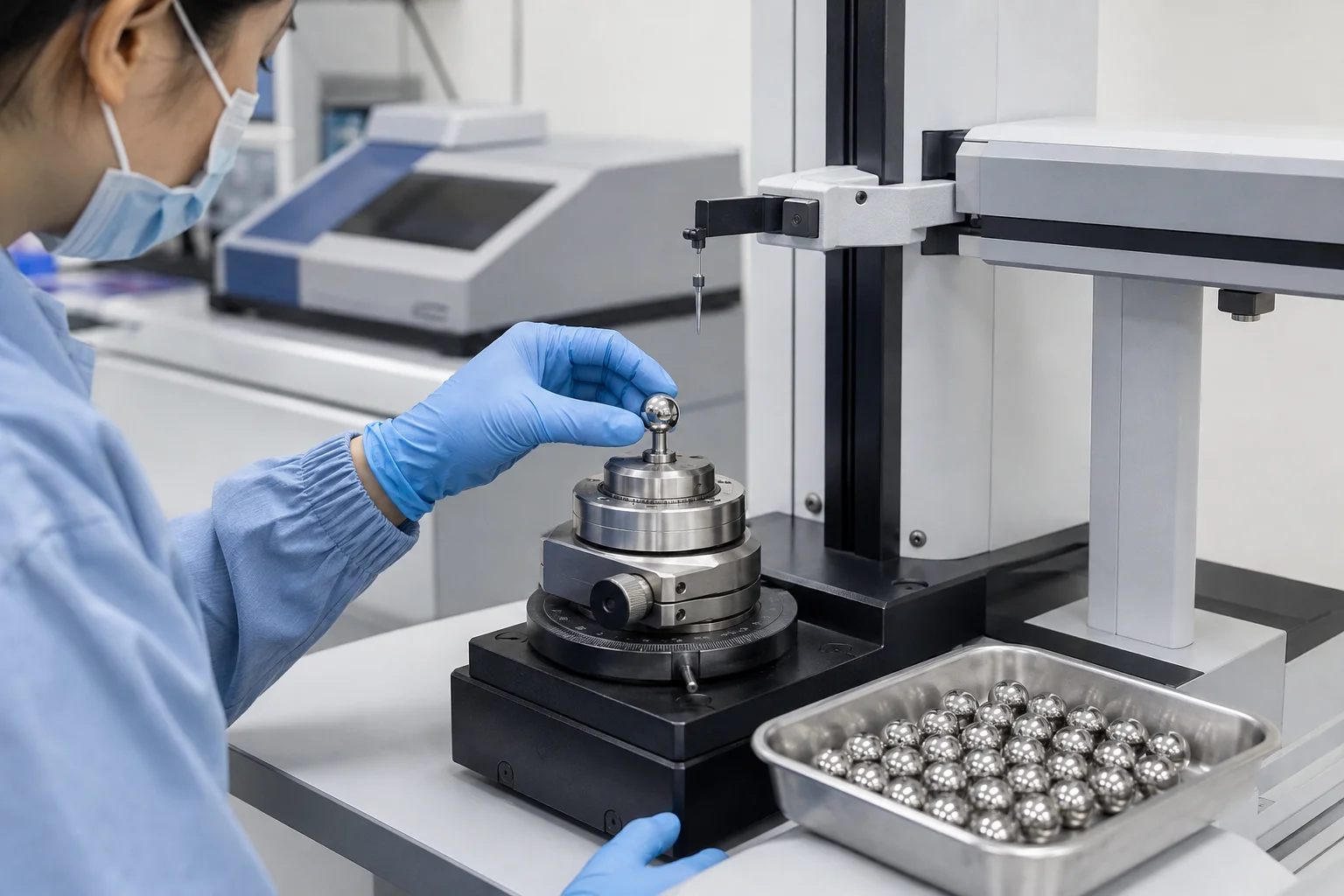
A Practical Compatibility and Package Validation Protocol
1. Define the Formula Risk Profile
Record at minimum:
pH and buffer system
Viscosity and test temperature
Ethanol and solvent content
Essential-oil and fragrance concentration
Chloride, salt, and active content
Expected fill temperature
Target shelf life and storage markets
2. Verify the Incoming Ball
For stainless steel:
Confirm 304/316L chemistry by spectrometer
Measure diameter and roundness
Inspect polish and cleanliness
Verify the agreed passivation acceptance test
Check residual magnetism where assembly equipment is sensitive
For plastic, glass, or ceramic:
Confirm resin or material grade and supplier declaration
Measure diameter, roundness, and lot variation
Inspect molding seams, chips, cracks, pores, and surface defects
Retain traceable samples from each lot
3. Run Formula Immersion Screening
A practical development matrix may include 4, 8, and 12 weeks at 25°C and 40°C, plus low-temperature and freeze–thaw conditions where relevant. Higher temperatures should be used only when the formulation team can justify them.
Check:
Ball mass and diameter change
Surface whitening, swelling, cracking, corrosion, or pitting
Formula color, haze, odor, pH, and viscosity
Iron, chromium, nickel, or molybdenum by ICP-MS when metal migration is a concern
Organic extractables by an appropriate chromatographic method when plastic compatibility is uncertain
Do not convert an accelerated test directly into a shelf-life claim without a validated kinetic model.
4. Test the Complete Package
Measure:
Breakaway force and running torque
Output per defined number of strokes
Film uniformity on the target surface
Leakage and mass loss in upright, inverted, and horizontal positions
Drop and transport performance
Function after formula dries around the seat
Consumer-relevant cooling and drag sensation
This system test is essential because leakage can be caused by the ball, housing tolerance, molding shrinkage, seat finish, formula surface tension, or a combination of these factors.
Regulatory and Quality Considerations
In the United States, FDA does not generally pre-approve cosmetic products, ingredients, or cosmetic packaging components, except for certain color additives. The responsible company must maintain adequate substantiation that the finished cosmetic product is safe.
In the European Union, Regulation (EC) No 1223/2009 requires a Cosmetic Product Safety Report. The European Commission’s Annex I guidance specifically identifies packaging as a possible source of product hazard. Material declarations are useful, but they do not replace finished-package safety and stability assessment.
Also note:
ISO 22716:2007 addresses cosmetic GMP; it is not a universal compatibility approval for a ball material.
ASTM A967/A967M and AMS2700 define passivation processes and verification approaches; they do not certify a finished cosmetic formula.
ISO 3290-1 and DIN 5401 address ball geometry and quality terminology; they do not establish cosmetic safety.
Why Work With Changzhou Eurasian Steel Ball Co., Ltd.
Changzhou Eurasian Steel Ball Co., Ltd. supports roll-on bottle and valve manufacturers with material verification, dimensional control, surface-quality management, and application-oriented technical communication.
Our quality and manufacturing capabilities include:
IATF 16949:2016 automotive quality management certification
GMPC (US) 2022 cosmetic GMP certification
ISO 22716:2007 cosmetic GMP certification
Bureau Veritas factory audit certification
An in-house CQI-9-aligned quenching and tempering line for grades that require controlled heat treatment
A dedicated inspection laboratory equipped with a roundness tester, Rockwell hardness tester, spectrometer, and vibration measurement equipment
For 304 and 316L cosmetic balls, our engineering focus is appropriately placed on alloy verification, roundness, surface finish, cleaning, and passivation. Heat-treatment capability is relevant to hardened grades, but it is not presented as the source of corrosion performance for austenitic 304/316L balls.
To request a technical recommendation, send us:
Formula type, pH, viscosity, alcohol level, essential-oil content, and salt/chloride information
Nominal ball diameter and annual quantity
Ball-seat or valve drawing
Desired output, cooling feel, and leakage target
Required regulatory market and validation plan
Our engineers can then recommend a controlled 304 or 316L roll-on bottle ball and define the inspection items that matter to your package.
FAQ About Roll-On Bottle Balls
What is the best material for roll-on bottle balls?
There is no universal best material. PP is usually best for low-cost water-based deodorants; borosilicate glass for many fragrance oils; stainless steel for cooling and viscous skincare; and alumina for high-value, low-interaction applications. Final selection requires formula and package testing.
Are 316L stainless steel balls always safe for perfume?
No material should be approved without testing. 316L generally offers better pitting resistance than 304 in many chloride-containing environments, but perfume stability still depends on alloy authenticity, polish, cleanliness, passivation, formula chemistry, light, temperature, and other package components.
Why can a fragrance turn yellow after contact with a steel ball?
Possible causes include free iron, incorrect alloy, polishing residue, inadequate cleaning or passivation, formula oxidation, light exposure, or interaction with another component. Compare control samples and analyze metal ions before assigning the failure to 304 or 316L itself.
Can PP balls be used with essential oils?
Sometimes, but not by assumption. Essential-oil constituents vary and may cause swelling, stress cracking, odor absorption, or dimensional change in a particular PP grade. Use supplier resistance data and conduct long-term testing with the finished oil blend.
Is POM better than PP for roll-on packaging?
POM is typically stiffer, denser, more wear-resistant, and lower-friction than PP. PP remains less expensive and may be preferable for high-volume aqueous products. POM is the better choice only when its added sliding and dimensional performance justifies the cost and the formula is compatible.
Do cosmetic roll-on balls need a G10 or G25 precision grade?
Usually not. Those grades originate from precision-ball and bearing applications. Cosmetic packaging should specify the diameter tolerance, roundness, roughness, lot variation, and defect limits needed for its housing and formula. Over-specifying a bearing grade can increase cost without reducing leakage.
Why do stainless steel roll-on balls feel colder than glass or plastic?
Stainless steel transfers heat away from the skin faster than plastic and has much greater mass at the same diameter. This produces the immediate cooling sensation valued in eye-serum and de-puffing applicators.
Does passivation prevent every stainless steel compatibility problem?
No. Passivation helps remove free iron and supports a clean passive surface. It cannot correct the wrong alloy, deep pits, embedded abrasive, poor rinsing, an incompatible formula, or leakage caused by the housing design.
Technical References
ISO 3290-1:2014—Rolling bearings, balls, Part 1: Steel balls
ASTM A967/A967M-25—Chemical passivation treatments for stainless steel parts
European Commission Guidelines on Annex I to Regulation (EC) No 1223/2009
SCHOTT Pharma—Controlled hydrolytic resistance in borosilicate glass
Engineering note: Material properties and test conditions in this article are screening guidance. Final limits must be agreed through drawings, purchase specifications, and validation using the actual formulation and complete roll-on package.


