


News

SS Steel Ball for Chemical Pumps Valves and Precision Motion Systems
Why Material Selection Matters in Precision Ball Applications
An ss steel ball is a critical component in many mechanical assemblies where dimensional accuracy, corrosion resistance, and consistent movement directly affect operating performance. Unlike general-purpose steel balls, stainless steel grades can provide a useful balance between surface durability and resistance to moisture, chemicals, and other demanding media. This makes them suitable for applications where ordinary carbon steel may experience corrosion, surface deterioration, or premature wear.
For chemical pumps, industrial valves, precision instruments, and motion components, ball performance depends on more than diameter alone. Material composition, hardness, roundness, surface condition, dimensional tolerance, and the operating environment all influence service life. Changzhou Eurasian supplies stainless steel precision balls in different grades and sizes, allowing customers to select a suitable material according to load, corrosion exposure, motion requirements, and required precision.
How Stainless Steel Balls Perform in Chemical Pumps
Chemical pumps often operate in environments where components are exposed to liquids that can accelerate corrosion or affect surface quality. An ss steel ball for chemical pumps needs to maintain a stable surface while supporting repeated movement, sealing, or flow-control functions. Stainless steel grades such as 304 and 316 are commonly selected when corrosion resistance is a primary requirement, while harder grades can be considered when wear resistance and mechanical durability are more important.
The right ball material helps reduce surface degradation during repeated operation. A smooth and accurately manufactured ball can also support consistent contact between mating components, reducing unnecessary friction and irregular movement. For chemical handling equipment, the selection should therefore consider both the chemical environment and the mechanical load rather than choosing a stainless steel ball based only on nominal size.
Corrosion Resistance for Demanding Fluid Environments
Corrosion resistance is one of the main reasons stainless steel precision balls are used in chemical and fluid-handling applications. 304 stainless steel balls provide good general corrosion resistance for many industrial environments, while 316 stainless steel balls offer stronger resistance in applications involving more aggressive conditions.
However, corrosion performance depends on the actual operating environment, including chemical concentration, temperature, moisture, exposure time, and surface condition. Selecting the appropriate stainless steel grade requires consideration of these factors together. A properly matched stainless steel ball for chemical applications can help maintain dimensional stability and reduce maintenance caused by surface corrosion.
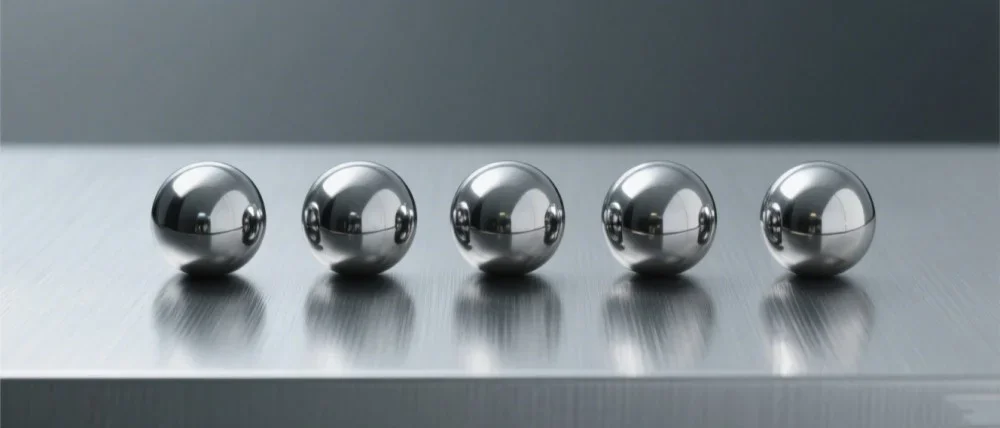
Stainless Steel Balls for Industrial Valves
Valves rely on controlled movement and reliable contact between internal components. A precision ball may serve as a moving or sealing element, depending on the valve construction and operating principle. In these applications, dimensional consistency is particularly important because excessive variation in diameter or roundness can affect contact, movement, and sealing performance.
An ss steel ball for industrial valves should therefore combine appropriate material properties with controlled manufacturing accuracy. Stainless steel is useful where moisture, process fluids, or cleaning agents may contact the component. For applications involving repeated mechanical movement, the balance between corrosion resistance and hardness becomes especially important.
Choosing Between Corrosion Resistance and Hardness
Different stainless steel grades provide different performance characteristics. Austenitic grades such as 304 and 316 are widely associated with corrosion resistance, while martensitic grades such as 420 and 440C can provide higher hardness after heat treatment. This distinction is important when selecting precision stainless steel balls for valves, pumps, and mechanical assemblies.
| Stainless Steel Grade | Primary Advantage | Typical Application Consideration |
|---|---|---|
| 304 | General corrosion resistance | Industrial, food, and general fluid applications |
| 316 | Enhanced corrosion resistance | Chemical and demanding fluid environments |
| 420 | Higher hardness | Wear-focused mechanical components |
| 440C | High hardness and wear resistance | Precision bearings and demanding motion parts |
The appropriate choice depends on the balance between corrosion exposure, mechanical load, wear conditions, and required surface performance. There is no single stainless steel grade suitable for every application.
Precision Control for Smooth Mechanical Movement
Precision motion applications place greater demands on ball geometry than ordinary mechanical uses. Even small variations in roundness, diameter, or surface finish can influence contact behavior when a ball operates repeatedly at high frequency or within a closely controlled assembly. This is why stainless steel precision balls are manufactured through controlled grinding and lapping processes.
Changzhou Eurasian produces precision balls across a range of sizes and precision grades, including G10 to G1000. These grades allow customers to match ball accuracy with the requirements of different applications. High-precision components can support smoother movement, more consistent contact, and better dimensional stability in assemblies where tight tolerances matter.
Surface Finish and Dimensional Accuracy
A precision ball must maintain a highly consistent spherical form rather than simply meeting a nominal diameter. Grinding and lapping help improve roundness and surface quality while controlling dimensional variation. For applications such as linear motion components, precision instruments, ball screws, and bearing assemblies, these characteristics can directly influence operating smoothness.
An ss steel ball with tight dimensional tolerance is particularly valuable where repeated contact occurs between closely matched components. Consistent geometry helps reduce irregular loading and can contribute to more predictable mechanical movement. The required precision level should always be selected according to the actual design tolerance rather than automatically choosing the highest available grade.
Matching Ball Hardness to Operating Conditions
Hardness plays an important role when stainless steel balls are exposed to repeated contact, friction, or mechanical loading. Grades such as 420 and 440C can be heat treated to achieve substantially higher hardness than corrosion-focused austenitic grades. This makes them suitable for applications where wear resistance is a major consideration.
At the same time, higher hardness does not automatically mean better overall performance. In a corrosive environment, selecting a highly hardened material without considering corrosion resistance may create a different performance limitation. The best stainless steel ball for industrial applications is determined by the combined requirements of mechanical stress, chemical exposure, surface contact, and service conditions.
Applications Beyond Pumps and Valves
Although chemical pumps and valves are important applications, stainless steel precision balls are also used in a broad range of industrial equipment. Their combination of corrosion resistance, dimensional accuracy, and mechanical durability makes them suitable for components that require controlled rolling or sliding movement.
Common applications include bearings, conveyors, roller skates, drawer slides, bicycles, castors, linear motion guides, ball screws, medical instruments, laboratory equipment, chemical dosing equipment, and precision mechanical assemblies. Food-processing equipment can also use suitable stainless steel grades where clean surfaces and corrosion resistance are important considerations.
The required ball characteristics vary significantly between these applications. A component used in a precision motion assembly may prioritize roundness and dimensional tolerance, while a chemical-processing application may place greater emphasis on corrosion resistance. Understanding the operating conditions before material selection helps prevent unnecessary over-specification or unsuitable material choices.
Selecting the Right SS Steel Ball for Industrial Use
Choosing an ss steel ball should begin with the application environment rather than the product name. The first considerations are normally the required diameter, load, operating speed, contact conditions, exposure to chemicals or moisture, and expected service life. These factors help determine whether corrosion-focused stainless steel or a harder martensitic grade is more appropriate.
Precision requirements should then be considered. Applications involving bearings, precision instruments, linear movement, or closely fitted mechanical components may require tighter tolerances and higher precision grades. For less demanding applications, an extremely high precision grade may not provide meaningful additional value.
Changzhou Eurasian can support selection according to material grade, ball diameter, precision grade, hardness, surface finish, and application requirements. Custom diameters, tolerances, and material options can also be considered when standard specifications do not match the requirements of a particular assembly.
Why Changzhou Eurasian Supplies Precision Stainless Steel Balls
Changzhou Eurasian focuses on stainless steel precision balls for industrial and mechanical applications where consistent quality is essential. The available material range includes 304, 316, 420, and 440C stainless steel, covering different combinations of corrosion resistance, hardness, and wear performance.
Manufacturing quality is supported by controlled heat treatment where required, precision grinding, and lapping processes for dimensional and surface control. Ball sizes can range from 0.5 mm to 50.8 mm, while precision grades from G10 to G1000 provide options for different levels of dimensional accuracy.
For customers purchasing stainless steel balls in volume or requiring specific specifications, material selection and dimensional requirements can be discussed before production. This approach helps ensure that the selected ss steel ball supplier provides components that correspond with the actual operating requirements rather than relying on a one-size-fits-all specification.
FAQ
What are ss steel balls commonly used for?
SS steel balls are used in bearings, valves, pumps, linear motion components, conveyors, medical equipment, chemical processing equipment, food-processing machinery, and precision mechanical assemblies. Their applications depend on the selected stainless steel grade, size, hardness, and precision level.
Which stainless steel grade is suitable for chemical applications?
304 and 316 stainless steel are commonly considered when corrosion resistance is important. 316 stainless steel balls are often selected for more demanding environments because of their enhanced corrosion resistance. The actual chemical composition, concentration, temperature, and exposure conditions should be evaluated before material selection.
Are stainless steel precision balls heat treated?
Heat treatment is commonly used for martensitic grades such as 420 and 440C to increase hardness and wear resistance. Austenitic grades such as 304 and 316 generally rely more on their corrosion-resistant characteristics and may be supplied in annealed or cold-worked conditions depending on requirements.
What precision grades are available?
Stainless steel precision balls can be manufactured in grades ranging from G10 to G1000, depending on the required application accuracy. The appropriate grade should be determined by the dimensional tolerance and movement requirements of the finished component rather than simply selecting the highest precision available.
Can stainless steel balls be customized?
Yes. Customers can request different diameters, stainless steel grades, precision tolerances, hardness levels, and surface finishes according to application requirements. Custom specifications are particularly useful for equipment manufacturers and industrial buyers working with non-standard mechanical assemblies.
How should an ss steel ball be selected?
The selection should consider corrosion exposure, mechanical load, wear conditions, operating speed, required diameter, dimensional tolerance, surface finish, and expected service life. Matching these factors with the appropriate stainless steel grade helps achieve reliable performance in pumps, valves, precision motion components, and other industrial applications.


