


News

Precision Ceramic Balls for Hybrid Bearings and High Speed Spindles
Why Ceramic Ball Technology Matters at High Rotational Speeds
High rotational speed places demanding requirements on bearing components. As speed increases, friction, heat generation, centrifugal loading, lubrication requirements, and dimensional stability become increasingly important. Conventional steel balls remain widely used, but their higher density can contribute to greater centrifugal forces and heat generation during continuous high-speed operation. Precision ceramic balls offer a different material approach, combining low density, high hardness, low thermal expansion, and strong wear resistance to address several of these challenges at the component level.
For hybrid bearings and high-speed spindle assemblies, the ball material directly influences running characteristics and service life. Ceramic materials are substantially lighter than steel while maintaining high mechanical strength and dimensional stability. This makes them suitable for applications where rotational speed, friction control, temperature resistance, and long-term precision are critical. Depending on the operating environment, manufacturers can select silicon nitride, alumina oxide, or zirconia ceramic balls to achieve different performance characteristics.
How Precision Ceramic Balls Reduce High Speed Bearing Loads
One of the fundamental advantages of ceramic balls is their lower density. Silicon nitride ceramic balls, for example, weigh approximately 60% less than comparable steel balls. Lower mass reduces centrifugal loading as rotational speed rises, which can help control internal bearing forces and support smoother operation at high speeds. The benefit becomes particularly relevant in high-speed bearings where conventional metallic rolling elements can experience increased mechanical and thermal demands.
Ceramic materials also provide a low coefficient of thermal expansion, helping maintain dimensional stability when operating temperatures change. Silicon nitride additionally has low thermal conductivity, which can influence how heat moves through the bearing assembly. Combined with lower friction and reduced lubrication requirements, these characteristics make ceramic rolling elements suitable for high-speed spindles, machine tools, and other precision applications.
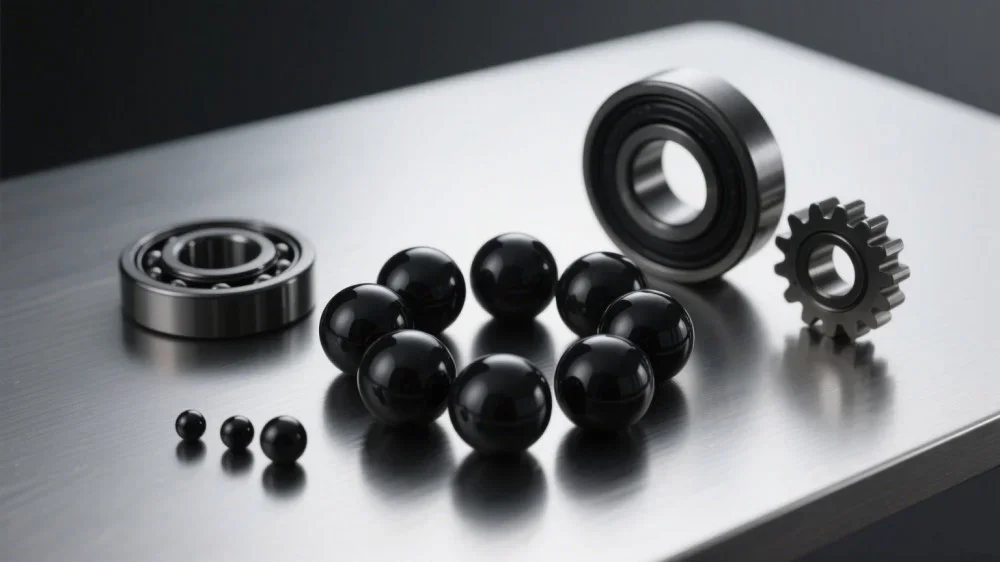
Material Selection for Ceramic Bearing Balls
Different ceramic materials offer distinct combinations of hardness, toughness, chemical resistance, temperature performance, and electrical properties. Selecting the correct material should therefore begin with the operating environment rather than simply choosing the hardest available option. Load, speed, temperature, lubrication, chemical exposure, required precision, and contact conditions all affect the appropriate ceramic composition.
| Ceramic material | Key characteristics | Typical applications |
|---|---|---|
| Silicon Nitride | Low density, high hardness, low friction, thermal stability | Hybrid bearings, high-speed spindles |
| Alumina Oxide | Chemical resistance, electrical insulation, high-temperature capability | Pumps, valves, flowmeters, medical equipment |
| Zirconia Oxide | High toughness, wear resistance, corrosion resistance | Bearings, valves, pharmaceutical and chemical equipment |
Among these options, silicon nitride ceramic balls are particularly relevant to high-speed bearing applications because they combine low weight with high strength and excellent wear resistance. Alumina ceramic balls are attractive where chemical stability and electrical insulation are important, while zirconia ceramic balls provide a useful balance of toughness, hardness, and corrosion resistance for demanding mechanical environments.
Silicon Nitride Balls for High Speed Spindles
High-speed spindle applications require rolling elements capable of maintaining stable contact conditions while limiting friction and heat generation. Silicon nitride has become an important ceramic material for these requirements because it offers high hardness, fracture toughness, shock resistance, and dimensional stability. Its non-magnetic nature also provides advantages in applications where magnetic interference or electrical characteristics must be carefully controlled.
The combination of low density and high elasticity allows silicon nitride precision balls to perform under demanding rotational conditions without relying on excessive lubrication. They can retain substantial strength and hardness at elevated temperatures, making them suitable for applications where operating conditions exceed the practical range of many conventional bearing materials. These characteristics are especially relevant to hybrid ceramic bearings used in high-speed rotating equipment.
Precision Grades and Surface Quality Matter
Material selection alone does not determine the performance of a ceramic ball. Diameter accuracy, roundness, surface finish, material uniformity, and precision grade are equally important when rolling elements are used in precision bearings or high-speed mechanisms. Small variations in geometry can influence contact stress, vibration, noise, and rotational stability, particularly when the bearing operates at high speed.
Precision ceramic balls are commonly supplied in different grades according to dimensional and geometric requirements. Higher precision grades are generally selected when tighter control of ball diameter variation and spherical accuracy is required. For engineering procurement, buyers should evaluate the required grade together with ball diameter, bearing design, rotational speed, load, and operating environment instead of treating grade as an isolated specification.
Ceramic Balls Versus Steel Rolling Elements
The decision between ceramic and steel rolling elements depends on the performance priorities of the application. Ceramic balls are lighter and harder than steel, while also providing strong corrosion resistance and lower friction characteristics. They can therefore be advantageous where high rotational speed, reduced wear, electrical insulation, or resistance to aggressive environments is required.
Steel remains appropriate for many conventional bearing applications, particularly where cost, load requirements, and operating conditions do not justify a ceramic solution. Hybrid bearings provide an intermediate configuration by combining ceramic balls with steel rings, allowing engineers to obtain many of the rotational benefits of ceramic rolling elements without converting every bearing component to ceramic.
Key Performance Factors in Ceramic Ball Selection
A technically appropriate ceramic ball should be selected according to the complete operating envelope. Speed determines centrifugal effects and frictional heating, while load influences contact stress and fatigue behavior. Temperature affects material stability and lubrication, and chemical exposure can determine whether alumina, zirconia, or silicon nitride is more suitable.
| Selection factor | Why it matters |
|---|---|
| Ball diameter | Influences contact geometry and bearing performance |
| Precision grade | Controls dimensional and geometric accuracy |
| Rotational speed | Affects centrifugal loading and frictional heat |
| Operating load | Determines contact stress and mechanical demands |
| Temperature | Influences material stability and lubrication |
| Chemical environment | Determines corrosion and chemical resistance |
| Lubrication | Affects friction, heat generation, and service life |
For buyers sourcing ceramic precision balls for bearings, providing complete operating information can significantly improve material and grade selection. A technically accurate quotation should normally consider ceramic type, diameter, precision grade, quantity, application conditions, surface requirements, and any certification or inspection requirements.
Corrosion and Chemical Resistance for Industrial Applications
Ceramic rolling elements can provide important advantages in environments where conventional steel components are exposed to corrosion or chemical degradation. Alumina oxide ceramic balls offer strong resistance to many acids, chemicals, water, and salt solutions. Their non-porous structure and electrical insulating properties make them suitable for chemical processing, valves, pumps, measurement equipment, and other applications requiring stable material behavior.
Zirconia ceramic balls provide another option where high toughness, wear resistance, and chemical inertness are important. Zirconia can resist caustic substances, organic solvents, molten metals, and many acids, making it suitable for demanding industrial environments. The appropriate material should still be selected according to the specific chemical concentration, temperature, contact conditions, and expected service duration.
Manufacturing Control for Consistent Ceramic Ball Quality
Producing high-quality ceramic balls requires more than forming ceramic material into a spherical shape. High-purity raw materials, controlled sintering, precision grinding, and comprehensive inspection all contribute to the final dimensional and mechanical characteristics. Sintering technologies such as GPS and HIP can be used according to material and performance requirements, while subsequent grinding processes refine the ball geometry and surface condition.
At Eurasian, manufacturing and quality control are supported by IATF 16949:2016 certified processes and established inspection practices. Experience in chrome steel, stainless steel, carbon steel, aluminum, and ceramic precision balls provides a broad materials background for customers sourcing different types of precision rolling elements. Consistent process control is particularly important when ceramic balls are used in high-speed bearings where small variations can influence running performance.
Global Supply Considerations for Precision Ceramic Balls
For international buyers, product performance is only one part of the sourcing decision. Consistent production capacity, packaging quality, documentation, inspection support, and communication can all affect procurement efficiency. Customers purchasing ceramic balls for sale in different quantities may require anything from small development batches to continuous industrial supply, making flexible production and packaging capabilities valuable.
Eurasian supplies precision balls for automotive, industrial machinery, bearing, and other international applications. Its portfolio includes ceramic and metallic ball materials, allowing buyers to coordinate different rolling-element requirements through one manufacturing source. Flexible MOQs, customized packaging, engineering communication, and export experience can also support qualification and long-term procurement planning.
When Precision Ceramic Balls Are the Right Choice
Precision ceramic balls are most relevant when an application places strong emphasis on high rotational speed, low friction, reduced mass, corrosion resistance, electrical insulation, or extended wear performance. Hybrid bearings are particularly useful when ceramic rolling elements are required while retaining steel bearing rings for a practical balance between performance and cost.
The material should ultimately be matched to the actual operating conditions. Silicon nitride is well suited to high-speed and high-performance bearing applications, alumina is valuable for chemical resistance and insulation, and zirconia offers high toughness and durability. By evaluating material, precision grade, geometry, load, speed, temperature, and environment together, engineers can select ceramic rolling elements that better match the requirements of the finished bearing or rotating assembly.
FAQ
What are precision ceramic balls used for?
Precision ceramic balls are used in hybrid and full ceramic bearings, high-speed spindles, pumps, valves, flowmeters, automotive components, medical equipment, and precision machinery. Their low density, hardness, wear resistance, and corrosion resistance make them suitable for applications where conventional steel balls may not provide the required combination of properties.
Why are silicon nitride balls used in hybrid bearings?
Silicon nitride offers low density, high hardness, strong fracture toughness, low friction, and good thermal stability. These properties make Si3N4 ceramic balls particularly suitable for high-speed hybrid bearings and spindle applications where reducing centrifugal loading and maintaining stable rotational performance are important.
How do alumina and zirconia ceramic balls differ?
Alumina ceramic balls are known for chemical resistance, electrical insulation, hardness, and high-temperature capability. Zirconia ceramic balls provide higher toughness and strong resistance to wear and corrosion. The appropriate choice depends on load, temperature, chemical exposure, speed, and mechanical requirements.
Are ceramic balls better than steel balls?
Ceramic and steel balls serve different engineering requirements. Ceramic balls offer lower density, high hardness, low friction, corrosion resistance, and non-magnetic properties, while steel balls remain widely used for applications where conventional metallic bearing performance and economic considerations are appropriate. The selection should be based on operating conditions rather than material type alone.
What information is needed when ordering ceramic precision balls?
Buyers should provide the ceramic material, ball diameter, precision grade, quantity, operating speed, load, temperature, lubrication conditions, and environmental requirements. Surface finish, cleanliness, inspection standards, packaging, and certification requirements may also be relevant for precision or regulated applications.
How does Eurasian support ceramic ball procurement?
Eurasian combines experience in precision ball manufacturing with international OEM and export support. Its capabilities cover ceramic and metallic precision balls, with quality control, flexible quantities, customized packaging, documentation support, and engineering communication available for different industrial requirements.


