


News

?Drilled Steel Balls Buyer's Guide: How to Choose the Right Configuration for Your Application
TL;DR: Quick Decision Guide
When to Choose Each Type:
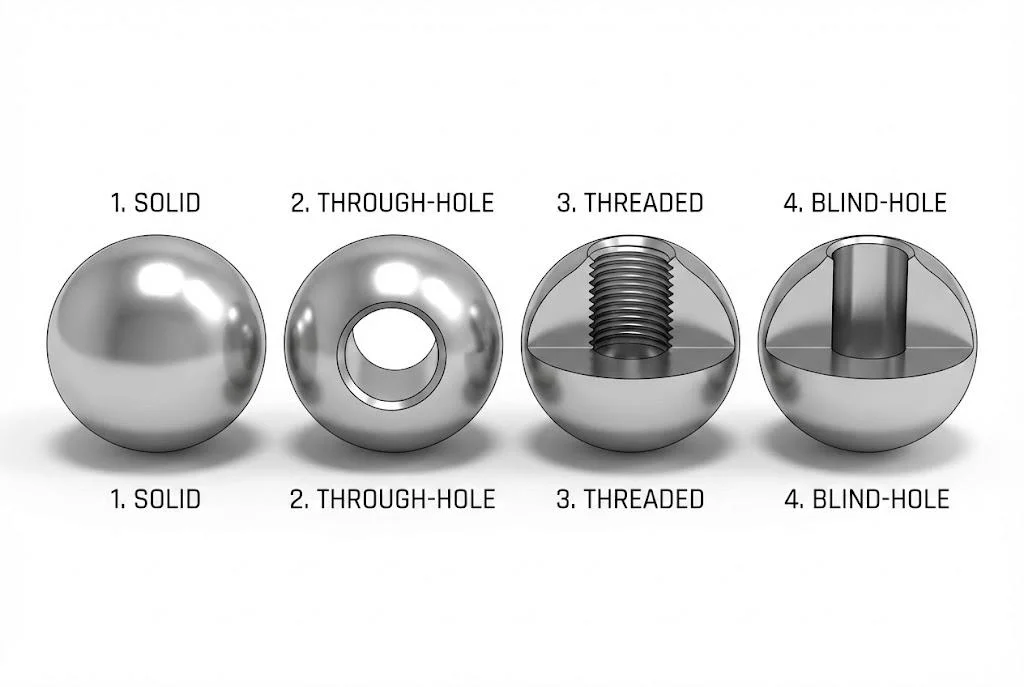
Solid Steel Balls: Maximum load capacity needed (bearing applications, high-vibration environments) | Precision grades G10–G28 | No assembly flexibility required
Through-Hole Steel Balls: Pin or shaft mounting required | Need field replaceability | Assembly cost matters more than unit price | Typical hole: 15-40% of ball diameter
Threaded Steel Balls: Frequent disassembly expected | No welding allowed | Moderate torque loading (<50 Nm for M5) | Best for furniture hardware, adjustable mechanisms
Blind-Hole Steel Balls: Weight reduction critical (10-30% savings) | Maintain one sealing surface | Valve assemblies, aerospace components
Most Common Buying Mistakes:
Undersizing ball diameter for thread strength (use minimum 2.5× thread diameter)
Ignoring post-drilling hardness recovery (HRC can drop 15-20 points without re-treatment)
Over-specifying precision for non-critical parts (G28 vs G200 = 40% cost difference)
When designing mechanical assemblies that require steel balls , engineers face a critical decision: should the ball have a hole, and if so, what type? This choice directly impacts assembly cost, serviceability, and long-term reliability.
This guide walks through the decision framework based on our experience manufacturing drilled steel balls for automotive, valve, and machinery customers under IATF 16949:2016 quality systems.
How to Decide: 5-Question Decision Tree
Question 1: What Load Will the Ball Experience?
High Dynamic Load (>500N) or Impact→ Recommendation: Solid steel balls
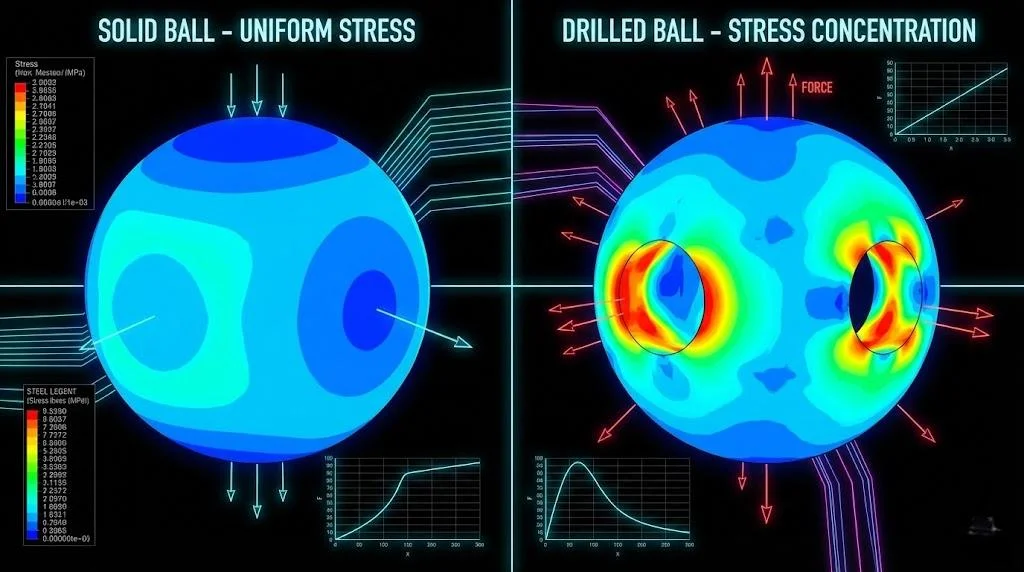
Why: Holes create stress concentrators that reduce fatigue life by 20-35%
Typical Use: Ball bearings, automotive CV joints, high-speed machinery
Material: Chrome steel balls GCr15 with HRC 60-65
Moderate Static Load (<500N)→ Recommendation: Drilled balls acceptable
Hole Impact: Reduces load capacity by 15-25% depending on hole size
Design Rule: Keep hole diameter under 40% of ball diameter
Verification: We can provide FEA analysis for custom load cases
Primarily Mounting/Positioning Function→ Recommendation: Through-hole or threaded configurations
Material Options: Carbon steel with plating, or 304 stainless for corrosion resistance
Tolerance: G100–G200 grades sufficient (cost-effective)
Question 2: Does It Need to Be Disassembled?
Never / Permanent Assembly→ Recommendation: Solid balls with welding
Assembly Cost: Higher labor but lower unit cost
Best For: High-volume production (>10,000 pcs/year)
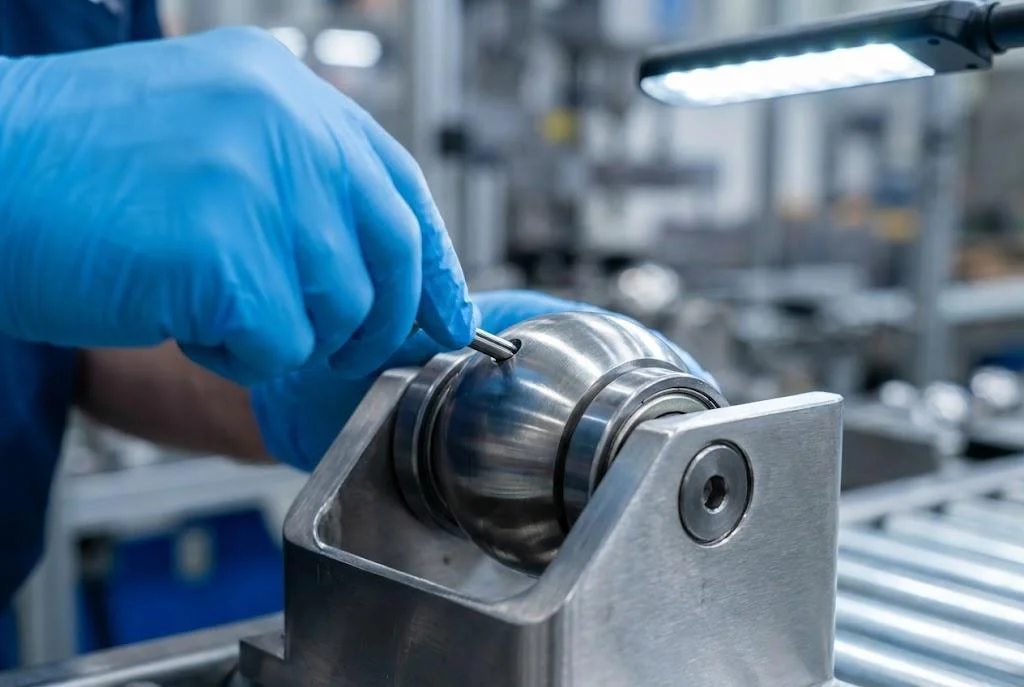
Occasional Service Access→ Recommendation: Through-hole with roll pins
Key Advantage: No special tools needed for field replacement
Real Example: Conveyor roller assemblies—maintenance teams can swap balls in 2 minutes vs 15 minutes with welded designs
Frequent Adjustment/Replacement→ Recommendation: Threaded steel balls
Thread Options: M3, M4, M5, M6 most common
Application: Furniture leveling feet, adjustable linkages, test fixtures
Cost Note: 35-50% premium over solid balls, but eliminates welding equipment costs
Question 3: What's the Corrosion Environment?
Indoor / Dry Conditions→ Material: Carbon steel with zinc plating (12 microns minimum)
Cost: Most economical option
Limitation: Not suitable for >60°C or outdoor exposure
Outdoor / Humidity→ Material: Stainless steel 304
Corrosion Resistance: Based on ASTM B117 salt spray testing, 304 typically withstands 200+ hours before visible corrosion (actual performance varies by specific environment)
Application: Marine hardware, outdoor furniture, agricultural equipment
Chemical Exposure / Food Contact→ Material: 316 stainless steel
Compliance Note: We maintain production controls aligned with GMP principles and can provide documentation for customer audits or regulatory submissions (material composition certificates, process flow records, cleaning validation data). Customers should evaluate suitability based on their specific regulatory requirements.
Post-Drilling Treatment: Passivation per ASTM A967 to restore corrosion resistance
Question 4: Is Welding Prohibited?
Welding Is Acceptable→ Recommendation: Solid balls (lower total cost at high volumes)
No Welding Allowed (cleanroom, explosive atmospheres, field assembly) → Recommendation: Drilled or threaded balls
Assembly Methods: Roll pins, set screws, threaded fasteners
Safety Benefit: Eliminates hot work permits in hazardous locations
Question 5: What Precision Grade Do You Actually Need?
Critical Bearing Applications→ Grade Range: G10–G28 (per ISO 3290 tolerance system)
Measurements Controlled: Spherical deviation, diameter variation within batch, surface roughness
Testing: We verify these parameters using Talyrond roundness measurement systems
Cost Impact: Base price (G28 reference)
Precision Jigs / Fixtures→ Grade Range: G28–G100
Cost: Base to +15%
General Mechanical / Furniture→ Grade Range: G100–G500
Cost: Base -20% to -30%
Important: Overpaying for G28 precision on furniture balls wastes budget
Material Selection Guide for Drilled Steel Balls
Chrome Steel (GCr15 / AISI 52100)
Why It Dominates Industrial Applications:
Post-Drilling Hardness: With proper heat treatment, we can maintain HRC 58-65 after drilling operations
Machinability: Easier to drill/thread than hardened stainless steel (30% faster cycle times)
Cost Efficiency: Approximately 30-40% lower material cost than 440C stainless
Our Heat Treatment Process (CQI-9 Certified Line):
Localized induction hardening of drilled surfaces
Tempering at 160°C for stress relief
Hardness verification via Rockwell testing (statistical sampling per control plan)
When NOT to Use Chrome Steel:
Outdoor exposure without protective coating
Food/pharmaceutical contact surfaces (rust risk)
Marine environments
Stainless Steel Options
304 Stainless Steel
Hardness: Approximately HRC 25-30 in annealed condition
Corrosion: General-purpose outdoor resistance
Cost: Moderate
Limitation: Lower hardness may cause galling in threaded connections under high torque
316 Stainless Steel
Corrosion Upgrade: Better performance in chloride environments (marine, chemical processing)
Cost: +15-20% vs 304
Documentation: We can provide material composition certificates traceable to heat lot
420/440C Stainless Steel
Hardness Potential: Can achieve HRC 40-50 through heat treatment
Trade-off: More expensive (+50-80% vs 304) and harder to machine
Best Use: When both corrosion resistance AND hardness are required
Carbon Steel (Cost-Optimized Choice)
When It Makes Sense:
Non-critical mechanical linkages
Indoor furniture hardware
Prototype development before tooling investment
Budget-constrained projects
Mandatory Surface Treatment:
Zinc plating: 8-12 microns minimum (we can provide plating thickness reports)
Black oxide: For aesthetic applications where rust is not a concern
Storage: VCI (Vapor Corrosion Inhibitor) packaging for long-term inventory
Critical Engineering Considerations
Sphericity Impact After Drilling
The Challenge:Drilling creates asymmetric material removal that can affect roundness.
Our Quality Control Approach:
Pre-Drilling: Verify incoming balls meet specified G-grade using roundness measurement
Post-Drilling: Re-measure representative samples to confirm tolerance maintenance
Typical Results: For balls ≥10mm diameter, we can reliably hold G100 or better after drilling
Traceability: Inspection records available per batch for customers with traceability requirements
What We Cannot Guarantee:Achieving G10-G20 precision on drilled balls <8mm diameter (tool deflection and fixturing challenges make this economically impractical)
Hole Position Accuracy
Why It Matters:In automated assembly, hole misalignment causes:
Pin insertion failures during production
Eccentric loading in ball joints (premature wear)
Increased scrap rate at final assembly
Achievable Tolerances at Our Facility:
Concentricity: ±0.05mm for balls 6-20mm diameter (measured as runout on CMM)
Perpendicularity: Within 0.02mm across hole axis
Sampling Plan: We inspect at defined frequencies per control plan; 100% inspection available for critical applications at additional cost
Thread Strength in High-Stress Applications
Case Study: Automotive Seat Belt Component (Anonymous customer; parameters verified through production records)
Customer Requirement:
M5 threaded steel balls for automotive seat belt retractors
Pull-out strength target: >2500N (referencing FMVSS 209 crash safety standard)
Thread engagement: Minimum 6mm depth
Corrosion testing per customer specification
Our Solution:
Material: GCr15 with additional surface treatment post-threading
Thread coating: Electroless nickel plating 10-15 microns
Verification: Tensile pull-out testing on sample basis (test reports retained per IATF 16949 record retention requirements)
Documentation Available Upon NDA:
Dimensional inspection reports
Pull-out test data
Material certificates
Process FMEA records
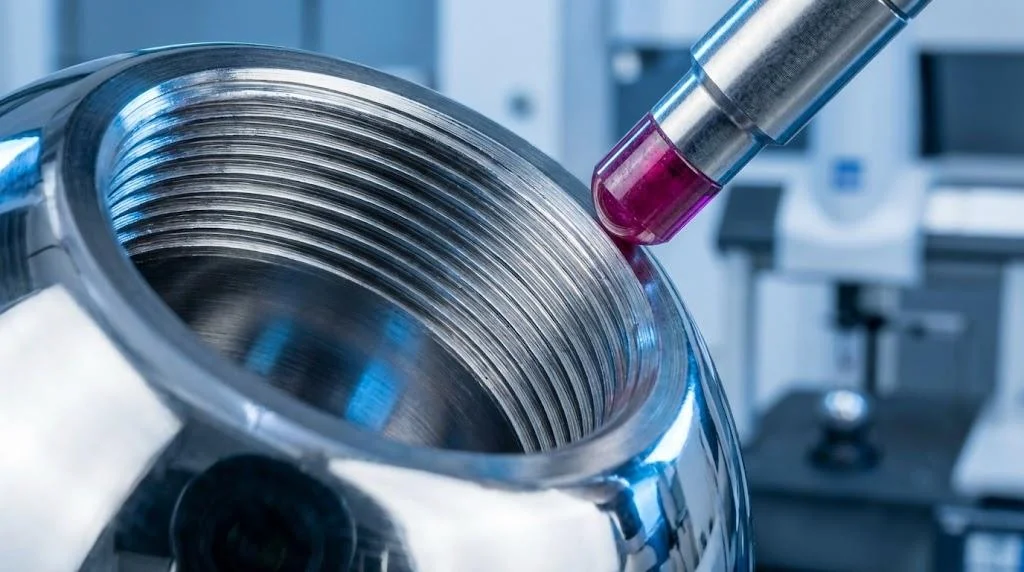
Application-Specific Selection Examples
Conveyor Systems & Material Handling
Typical Specification:
Material: Carbon steel balls with zinc plating
Configuration: Through-hole (?3-5mm hole)
Grade: G200 (cost-effective for non-bearing roller applications)
Assembly: Roll pin mounting
Why Drilled vs Solid?Maintenance advantage: Roller balls can be replaced in-field by removing pin, no cutting/welding required. Based on customer feedback, this reduces downtime compared to welded assemblies.
Valve Assemblies (Pneumatic/Hydraulic)
Design Requirement:
Material: 316 stainless steel for fluid compatibility
Configuration: Blind hole (50% depth) to preserve one sealing surface
Surface finish: Ra 0.2μm on sealing hemisphere
Quality Documentation:Our production system (verified through Bureau Veritas factory audits) maintains batch traceability from raw material to finished part. Customers can request:
Material composition reports
Dimensional inspection data
Surface finish measurement records
Furniture Hardware (Ball-and-Socket Joints)
Cost-Optimized Specification:
Material: Low carbon steel (C1010/C1015)
Configuration: M4 or M5 threaded
Coating: Black oxide (hidden connections) or decorative chrome plating
Tolerance: G500 acceptable (aesthetic/low-load applications)
Volume Pricing Advantage:For furniture OEMs ordering >50,000 pcs/year, threaded carbon steel balls often have lower total installed cost than solid balls + welding labor.
Quick RFQ Module: Get a Quote in 48 Hours
Provide These 5 Key Specifications:
Ball Diameter: _____ mm (range: 3mm–60mm)
Material Preference:
[ ] GCr15 Chrome Steel (bearing quality)
[ ] 304 Stainless Steel (corrosion resistance)
[ ] 316 Stainless Steel (marine/chemical)
[ ] Carbon Steel (cost-optimized)
[ ] Other: _____
Hole Configuration:
[ ] Through-hole → Diameter: _____ mm
[ ] Threaded → Thread size: M___ or UNC ___
[ ] Blind hole → Depth: _____ mm
[ ] No hole (solid ball)
Precision Grade (per ISO 3290):
[ ] G10–G28 (high precision)
[ ] G28–G100 (standard industrial)
[ ] G100–G500 (commercial grade)
[ ] Not sure—advise based on application
Annual Volume Forecast: _____ pieces/year
Application/Environment (optional but helps us recommend):
What You'll Receive:
Material and grade recommendation with technical justification
Pricing for prototype quantities (100-500 pcs) and production volumes
Lead time estimate
Sample inspection report (showing our measurement capabilities)
Upload Option: If you have a drawing or 3D model, attach it for faster review.
Cost Comparison: When Does Drilling Add Value?
Total Cost Example: 10,000 pcs of ?20mm Steel Balls
Scenario A: Solid Balls + Welded Assembly
Ball cost: $0.50/pc
Welding labor: $0.35/pc (equipment, consumables, inspection)
Estimated rework: 5% (weld defects)
Total: ~$0.88/assembly
Scenario B: Drilled Balls + Pin Assembly
Ball cost: $0.65/pc (+30% for drilling)
Pin insertion: $0.12/pc (manual or automated)
Estimated rework: <1% (dimensional fit issues)
Total: ~$0.78/assembly
When Drilled Balls Save Money:
Production volume >5,000 pcs (labor savings offset unit cost premium)
Field serviceability matters (replacement cost avoidance)
Assembly line lacks welding equipment
When Solid Balls Are Better:
Very low volume (<500 pcs) where tooling cost dominates
Maximum load capacity is non-negotiable
Welding infrastructure already exists
Common Specification Mistakes to Avoid
Mistake 1: Thread Too Deep for Ball Size
Problem:Specifying M5 thread in a ?12mm ball leaves thin walls that crack under torque.
Design Rule:Minimum ball diameter = Thread outer diameter × 2.5
Example:
M5 thread (5mm outer diameter) requires ≥?12.5mm ball
M4 thread → ≥?10mm ball
M6 thread → ≥?15mm ball
Mistake 2: Assuming Hardness Is Maintained After Drilling
Reality:Drilling and threading generate heat that can locally soften chrome steel (HRC may drop from 62 to 45 in drilled zone without re-treatment).
Solution:Specify "post-drilling heat treatment required" or choose stainless steel if hardness is less critical.
What We Do:Our CQI-9 certified line includes localized re-hardening after drilling to restore surface hardness. This is included in our standard process for GCr15 drilled balls.
Mistake 3: Over-Specifying Precision for Cost-Sensitive Parts
Example:Furniture caster ball specified as G28 (high precision) when G200 would function identically.
Cost Impact:G28 vs G200 can represent 30-40% price difference with zero functional benefit in low-load applications.
How to Right-Size:
Bearing applications → G10–G28
Precision fixtures → G28–G100
General mechanical → G100–G200
Furniture/aesthetic → G200–G500
FAQ: Drilled Steel Balls Technical Questions
Can drilling affect the hardness of chrome steel balls?
Yes—drilling and threading operations generate localized heat that can soften chrome steel in the affected zone. Without re-hardening, hardness may drop 15-20 HRC points around the hole.
Our Process:For GCr15 (chrome steel) drilled balls, we include localized induction hardening of the drilled surface followed by tempering. Post-treatment hardness is verified through statistical sampling per our quality control plan.
Documentation:Hardness test reports (Rockwell C scale) available upon request for production batches.
What's the smallest hole diameter you can drill reliably?
Technical Minimum: ?1.5mm (but with higher manufacturing variability)
Practical Recommendation: ?2.0mm or larger for:
Better tool life (reduced breakage risk)
Achievable tolerance of ±0.02mm
Adequate wall thickness for handling without deformation
For Smaller Holes:If your application absolutely requires holes
Do threaded steel balls need special rust prevention?
Thread roots are more vulnerable to corrosion initiation due to:
Increased surface area in recessed geometry
Stress concentration points where pitting can start
Difficulty achieving uniform coating coverage in threads
Our Standard Protection Options:
For Chrome Steel Threaded Balls:
Electroless nickel plating: 10-15 microns (provides uniform coverage including internal threads)
Post-plating hydrogen embrittlement relief: 190°C × 4 hours per ASTM B850
VCI packaging for long-term storage
For Stainless Steel:
Passivation treatment per ASTM A967 to maximize natural corrosion resistance
Clean manufacturing process to avoid iron contamination (which can cause rust even on stainless)
Testing Documentation:We can provide salt spray test reports (ASTM B117) conducted at defined intervals, showing time-to-first-corrosion on threaded vs non-threaded surfaces.
How do you ensure hole concentricity in production?
Process Controls We Use:
Fixture Design:
Self-centering 4-jaw chucks with ball-specific soft jaws to prevent deformation during clamping
Pneumatic pressure control (2-4 bar) to ensure repeatable grip force
CNC Programming:
Probe touch-off cycle to locate ball center before drilling (±0.005mm repeatability)
Peck drilling with chip evacuation intervals to prevent tool deflection
In-Process Verification:
Runout measurement using dial indicator (sampling frequency per control plan)
CMM (Coordinate Measuring Machine) dimensional verification on sample basis
Achievable Concentricity:±0.05mm for balls 6-25mm diameter (measured as total indicated runout on CMM).
Customer-Specific Requirements:Tighter tolerances may be achievable depending on ball size and quantity—please inquire with specific dimensional requirements.
Can you drill balls that I already have in inventory?
Yes, this is a common request for:
Design changes mid-project
Prototype modifications
Salvaging non-conforming parts from other suppliers
Information We Need:
Material type (GCr15, 304SS, carbon steel, etc.) and hardness state
Current diameter and quantity
Desired hole type (through-hole, threaded, blind hole) and dimensions
Feasibility Factors:
Hardness: Must be ≤HRC 45 for conventional drilling (harder materials require EDM which is costlier)
Size Range: Our equipment handles ?6mm–?60mm effectively
Condition: Balls must be free of surface cracks or prior damage
Lead Time: 2-3 weeks for quantities <1,000 pcs
MOQ: 100 pieces minimum for custom drilling service
What tolerances can you hold on threaded holes?
Thread Class Standards:
Class 2B (Standard Commercial):
Thread tolerance per ASME B1.1 (for metric: ISO 965-1)
Suitable for 90% of industrial mechanical assemblies
Cost-effective for production volumes
Class 3B (Precision):
Tighter pitch diameter tolerance
Required for high-vibration environments or frequent assembly/disassembly
Common in aerospace/medical applications
Verification Methods:
Thread ring gauges (GO/NO-GO) used for in-process inspection
Thread micrometers for statistical process control sampling
Pull-out strength testing available per customer specification
Documentation:First article inspection reports (FAIR) and production inspection records available per IATF 16949 requirements.
Why Work with Changzhou Eurasian Steel Ball
Quality System Certifications
IATF 16949:2016 (Automotive Quality Management)
Ensures process consistency for high-volume production
PPAP (Production Part Approval Process) documentation capability
Traceability from raw material certification through finished part inspection
GMP Certifications (For Regulated Industries)
US FDA GMPC 2022 & ISO 22716:2007: We maintain production controls aligned with Good Manufacturing Practice principles for customers in cosmetic/pharmaceutical sectors
Documentation support: Material composition certificates, process flow records, cleaning validation data
Important Note: Customers must evaluate regulatory suitability for their specific applications; we provide documentation to support their compliance efforts
Bureau Veritas (BV) Factory Audit
Third-party validation of manufacturing processes and quality systems
Annual surveillance audits maintain certification status
Manufacturing Capabilities
In-House Heat Treatment (CQI-9 Certified)
Quenching + tempering operations under one roof (no outsourcing risk)
Process monitoring with digital furnace logging for traceability
Eliminates transportation damage risk between process steps
Testing Laboratory Equipment
Roundness Measurement: Talyrond systems (sub-micron resolution)
Hardness Testing: Rockwell (HRC) and Vickers (HV) capability
Spectrometry: Optical emission spectrometer for material composition verification
CMM: Coordinate measuring machine for dimensional verification
Engineering Support
Design for Manufacturing (DFM) reviews at no charge
Material selection guidance based on application loads and environment
CAD modeling support for custom hole configurations
Flexible Order Quantities
Standard Products: 100 pcs minimum
Custom Drilling: 500 pcs minimum
Custom Threading: 1,000 pcs minimum
Prototype Service:
10-50 piece sample runs available
1-2 week turnaround for evaluation quantities
NDA protection for proprietary designs
Next Steps: Get Application-Specific Recommendations
Information That Helps Us Provide Accurate Guidance:
Ball diameter and material preference (GCr15 / 304SS / 316SS / Carbon steel)
Hole configuration (through-hole / blind hole / threaded) with dimensions
Operating environment (temperature range / corrosion exposure / load cycles)
Required certifications (IATF / material certs / dimensional reports)
Annual volume forecast (for production pricing)
Our Technical Team Will Provide:
Material and specification recommendations with technical justification
Sample inspection reports showing our measurement capabilities
Pricing for prototype and production quantities
Lead time estimates based on current production schedule
Response Time: Technical proposal within 48 business hours
Conclusion: Choosing the Right Drilled Ball Configuration
The decision between solid steel balls and drilled configurations should be based on:
Choose Solid Steel Balls When:
Maximum load capacity and fatigue life are critical
Operating in high-vibration environments (bearing applications)
Ultra-high precision required (G10-G28 grades)
Welding is acceptable and production volume justifies tooling
Choose Through-Hole Steel Balls When:
Mechanical fastening preferred over welding
Field serviceability is important (maintenance access)
Pin or shaft mounting method suits the assembly design
Assembly labor cost matters more than unit price premium
Choose Threaded Steel Balls When:
Frequent disassembly/reassembly expected during service life
Clean aesthetics required (no external fasteners visible)
Torque loading is moderate and controlled
Application allows for slightly lower load capacity vs solid balls
Choose Blind-Hole Steel Balls When:
Weight reduction critical (aerospace, portable equipment)
Need to maintain one sealing surface (valve applications)
Mounting method only requires single-side access
At Changzhou Eurasian Steel Ball, our manufacturing experience with precision steel balls across automotive, valve, and industrial machinery applications enables us to provide guidance on drilled steel ball specifications that balance performance requirements with cost-effectiveness.
Contact our technical team to discuss how drilled steel ball configurations can optimize your mechanical assembly design.
Technical content based on manufacturing processes certified under IATF 16949:2016 quality management system | Material specifications referenced to ASTM/ISO standards | All testing claims supported by laboratory equipment capabilities and documented procedures


